Page views in the first full year: 0 to 1.6 million from a new domain
How Syllabus.ng Reached 1.6M Page Views From a Newly Registered Domain
Nigerian teachers were searching for schemes of work by the tens of thousands every term, and nobody owned the answer. The sites ranking for those searches were general education portals, where schemes of work were one topic among hundreds.
In 2024 I registered Syllabus.ng and set out to build the most complete, best organised scheme of work and syllabus resource in the country, with a team of interns I trained in SEO and content.
CLIENT:
Syllabus.ng
CATEGORY:
SEO & Content
Growth Problem
How do you take a newly registered .ng domain and make it the first place Nigerian teachers look for schemes of work, ahead of education portals with years of head start?
MY ROLE
I founded Syllabus.ng and led SEO end to end: site architecture, keyword strategy, content operations and training the team of interns who built the pages.
WHAT I BUILT
I designed a two-click site architecture of close to 300 class and subject pages, extended it to every major exam body and professional exam, and turned each free scheme of work into an email-gated PDF that doubled as an advert.
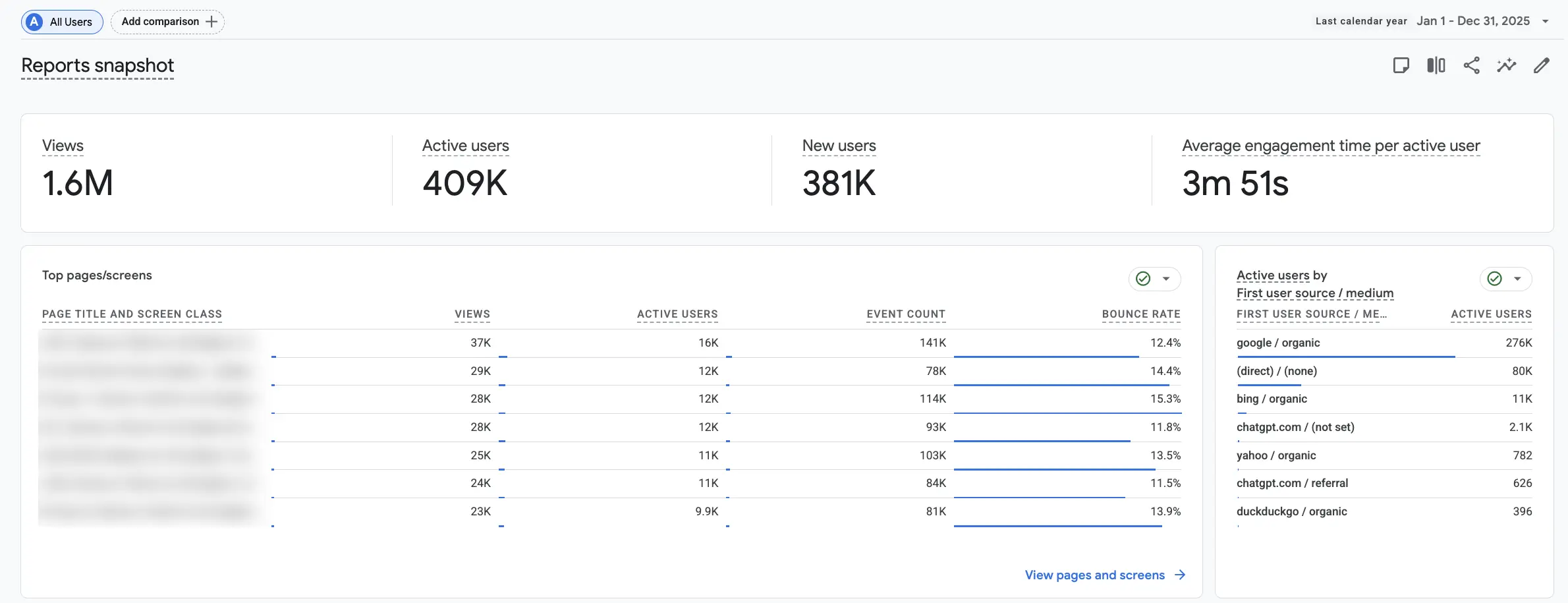
1.6M
Page views in 2025, the first full calendar year
786K
Google clicks in the last 12 months
1 in 4
Nigerian teachers surveyed had used or seen our materials
Skills applied
SEO
Programmatic SEO
Site Architecture
Content Strategy
Lead Generation
Team Training
Frameworks
Two-Click Architecture
Hub and Spoke Model
Jobs to Be Done
Page views and users in the in 2025 alone.
The opportunity
Every term, tens of thousands of Nigerian teachers, school owners and parents search for the same thing: the scheme of work for a specific class and subject. “JSS1 scheme of work.” “SS1 biology scheme of work.” “Primary 4 mathematics scheme of work.” The demand is huge, it repeats every resumption, and it is very specific.
When I looked at who was ranking for those searches, the answer was established education portals and blogs such as MySchool.ng, EduDelight, Schoolings.org and AllSchool.ng, with newer players like HeadTeacher.ng arriving later. They covered everything from admission news to exam tips, and schemes of work were one topic among hundreds, usually a single long post rather than a page per class and subject. Nobody had built a site that owned the intent end to end.
Then the Syllabus.ng domain turned out to be available. A domain that literally named what people were looking for, on Nigeria’s own extension, was too good to leave on the table. We registered it and set out to build the most complete, best organised scheme of work and syllabus resource in the country.
There was a second reason. I had been teaching SEO and content to a group of interns, and I wanted them to learn on something real, with real rankings and real users, rather than exercises. Syllabus.ng became their training ground and, in time, the project they put at the top of their own portfolios.
Architecture before a single article
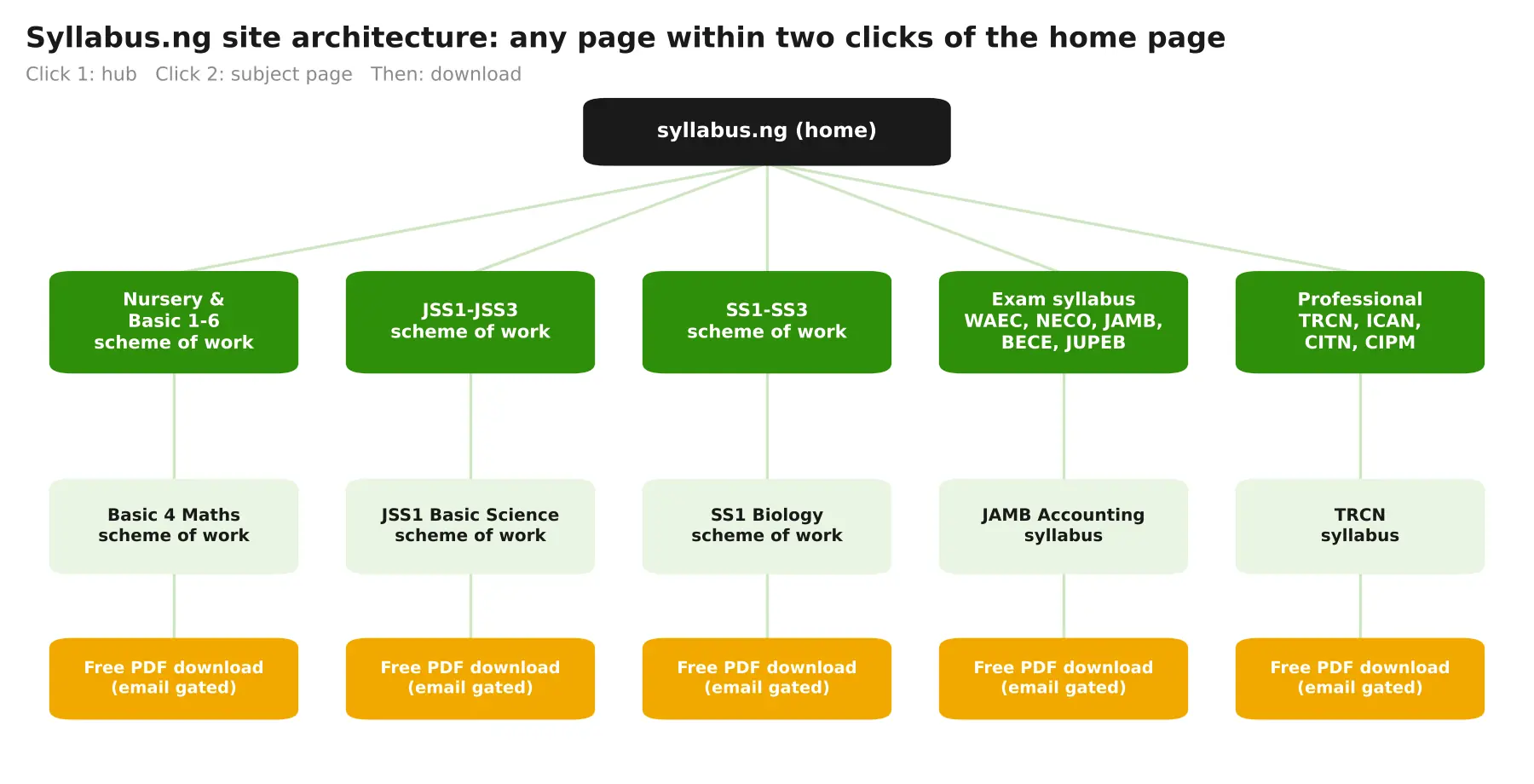
The first thing we did was not write. We drew the site. The rule was simple: any page on Syllabus.ng had to be reachable within two clicks of the home page. That keeps link equity flowing to every page, makes crawling easy, and means a teacher never has to hunt.
The main navigation has just five doors: Exam Syllabus, Professional Certification, Primary Scheme of Work, JSS Scheme of Work and SSS Scheme of Work. Every menu item opens straight onto a hub. We organised everything class by class: JSS1 to JSS3, SS1 to SS3, Basic 1 to Basic 6 and the nursery classes. Each hub was built to rank for its own head term, such as “JSS1 scheme of work”, because that is exactly how people search.
Each hub does more than list links. The SS1 hub opens with a short explanation of what the year is for, then groups its 28 subjects into core, science and technology, business, humanities and trade subjects. Every subject has two links side by side: the free scheme of work and the paid lesson notes for that subject. Breadcrumbs, links to the neighbouring classes and the main exam syllabuses, and article and organisation schema complete the page.
Going after the long tail, subject by subject
Under every class hub we built a page for every subject taught in that class, each on a clean URL such as syllabus.ng/ss1-scheme-of-work/biology. Senior secondary has more than 25 subjects, so SS1 to SS3 alone produced close to 80 pages. The junior secondary classes added almost 50 and the primary classes almost 100. With nursery included, the class structure alone gave us close to 300 tightly targeted pages, each aimed at a search with clear, repeat demand.
Every subject page follows the same template, which is what allowed a small team of interns to produce hundreds of them consistently. The SS1 Biology page, for example, is based on the Lagos State unified scheme of work and lays out all three terms as week-by-week tables of topics, followed by an assessment guide. Around that content sit the conversion points: a “Download Now” button, a banner for the complete SS1 Biology lesson notes, and an invitation to join our WhatsApp community.
The two-click architecture: home, class or exam hub, subject page, download
Expanding into exam and professional syllabuses
Once the class structure was ranking, we applied the same model to exam bodies. JAMB got a hub and a page for each of its 22 subjects, on URLs such as syllabus.ng/jamb/biology. We replicated it for WAEC, NECO, BECE, JUPEB and NABTEB, then went further into professional exams our general-blog competitors barely touched: TRCN for teachers, ICAN, CITN, CIPM and others. Around these we added the resources people search for in the same moment: past questions, a directory of JAMB CBT centres and a directory of ICAN tutorial centres.
Giving readers what they actually wanted
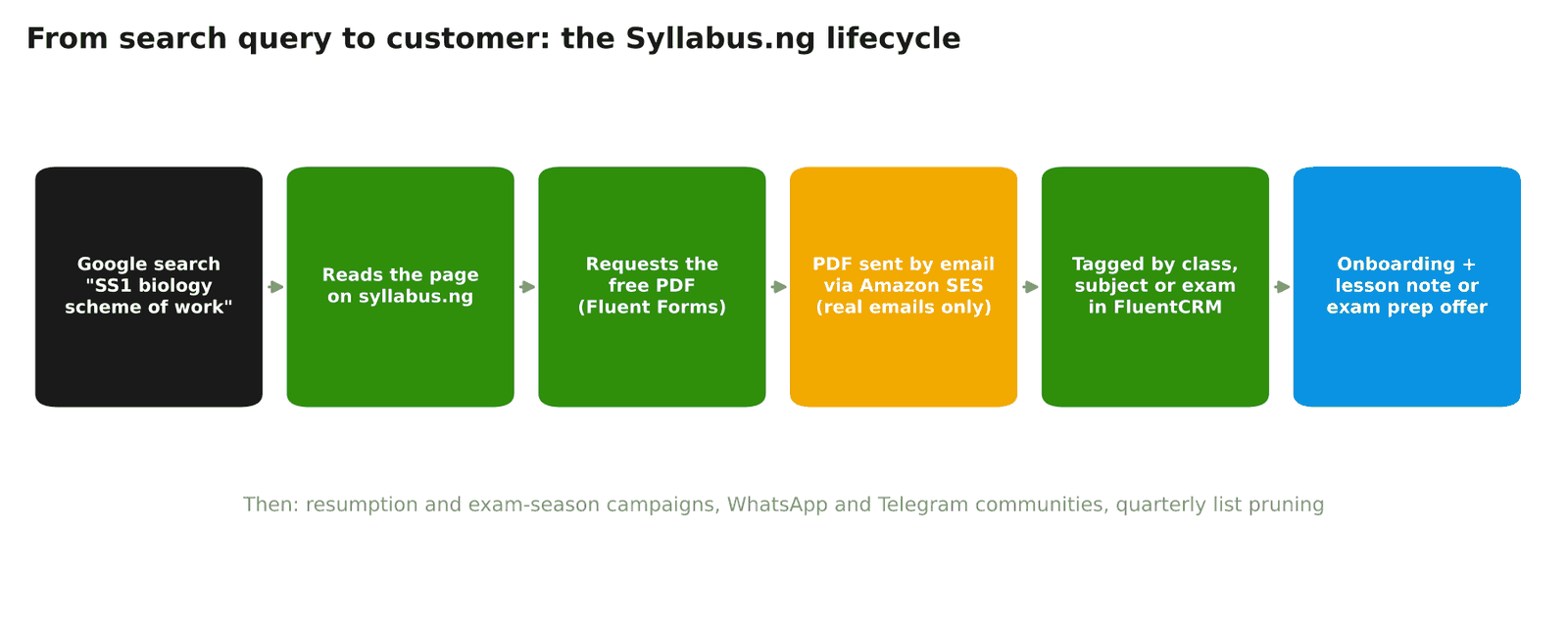
The traffic came, and people were reading. But the behaviour told us something: teachers wanted to take the scheme of work offline, print it and file it. So we built a downloadable PDF for every subject in every class. Anyone could read the full scheme of work for free, and if they wanted the PDF, they requested it with their email address and it was delivered to their inbox. That one decision turned an anonymous search audience into a known, segmented audience, and it is the foundation of the lifecycle programme I cover in a separate case study.
Building sharing into the download
We knew teachers would not keep our PDFs to themselves. A free scheme of work gets forwarded into staff-room WhatsApp groups, parent groups and teacher communities. So every PDF carried several advert placements: lesson notes for other subjects with a link to our business WhatsApp, an invitation to our teacher community, and links back to schemes of work for other classes and subjects. Anyone who received a forwarded copy, without ever having searched for us, could reach us in one tap. Every share became free distribution.
Keeping the site up when it mattered most
Demand on Syllabus.ng is brutally seasonal. The week before and the week after school resumes, traffic surges across every class at once. Our original shared hosting could not cope, and we were suspended for days at a time, back to back, during exactly those peak windows. We migrated to managed WordPress hosting built to absorb those spikes, and the site stabilised. Technical SEO is not only about crawlability. If the server falls over in your biggest week, no ranking can save you.
A classroom for SEO talent
The interns were not spectators. They owned real parts of the build: planning the architecture, researching subjects and keywords, writing and formatting the pages, preparing the PDFs and uploading them. They saw their own pages climb into the top results and drive real traffic. Most of them have since gone on to become strong SEO professionals in their own right. Two years on, that may be the result I am proudest of.
2025 sessions by source. Google organic dwarfs everything else, and ChatGPT is already a measurable referrer.
From search results to AI answers
Syllabus.ng was built before AI assistants changed how people search, but well structured, specific, genuinely useful pages travel well. ChatGPT now sends a steady stream of visitors to the site: over 4,000 sessions in 2025 and around 1,500 in the most recent 30 days alone. The same clarity that made the pages easy for Google to rank makes them easy for AI tools to cite.
What I learnt
Look for what is offline but not online. Plenty of things people rely on every day exist offline but not online, or only in scattered, poorly organised form. Finding and filling those gaps is where the easiest wins are.
Win a niche, not a category. You do not need to out-publish big generalist sites. You need to own one intent more completely than anyone else.
Architecture first. Decide the structure, URLs and internal linking before writing anything.
Template what repeats. A repeatable page template lets a small team, even a team of interns, produce hundreds of high quality pages consistently.
Hosting is an SEO decision. Choose a platform that scales with you rather than one that fails you at your peak.
SEO is not just traffic. Every page should have a path to a lead, and every lead a path to a paying customer.
Build virality into the asset. Assume people will share what you give them, and design it so every copy can bring someone back.
SEO builds brand affinity. When one in four teachers surveyed had used or seen your materials, search has stopped being only a traffic channel. It has become your brand.
What came next
Syllabus.ng was never only a traffic play. It became the top of the funnel for a commercial education business: free schemes of work bring teachers in, and lesson notes, exam questions and exam preparation products on the Syllabus.ng shop and LessonNotes.ng are what they buy next. How we built that bridge is the subject of my second Syllabus.ng case study, on CRM and lifecycle marketing.
From search query to customer: how a free scheme of work leads to a paid lesson note sale
Own the intent your market is searching for.
If your audience is already searching for something nobody answers well, there is a site to be built around it. I would love to help you plan the architecture, templates and conversion paths that turn that demand into leads and customers.