Google manual penalty lifted in four weeks, with organic search back to 51% of sales

How JerseyGram Lifted a Google Penalty and Made Organic Search 51% of Sales

In 2021, a malware attack and a flood of spam links left JerseyGram, a Nigerian online store for football and sports kits, with a Google manual penalty. Organic sales dried up.

Here’s how we cleaned the site, got the penalty lifted, and rebuilt the store so search became its biggest revenue channel again.

CLIENT:

JerseyGram

CATEGORY:

Penalty Recovery & Ecommerce SEO

JerseyGram logo

Growth Problem

How do you win back Google’s trust after a malware hack and a toxic link attack, and come back stronger than before?

MY ROLE

Lead consultant at Zaicon Digital. I led the security clean-up, penalty recovery, site rebuild, and SEO strategy.

WHAT I BUILT

I cleaned and secured the site, got the manual penalty lifted, migrated the store to a new domain, and rebuilt its structure, speed, checkout and content for growth.

4 weeks

To get the Google manual penalty lifted

3,371%

Return on investment

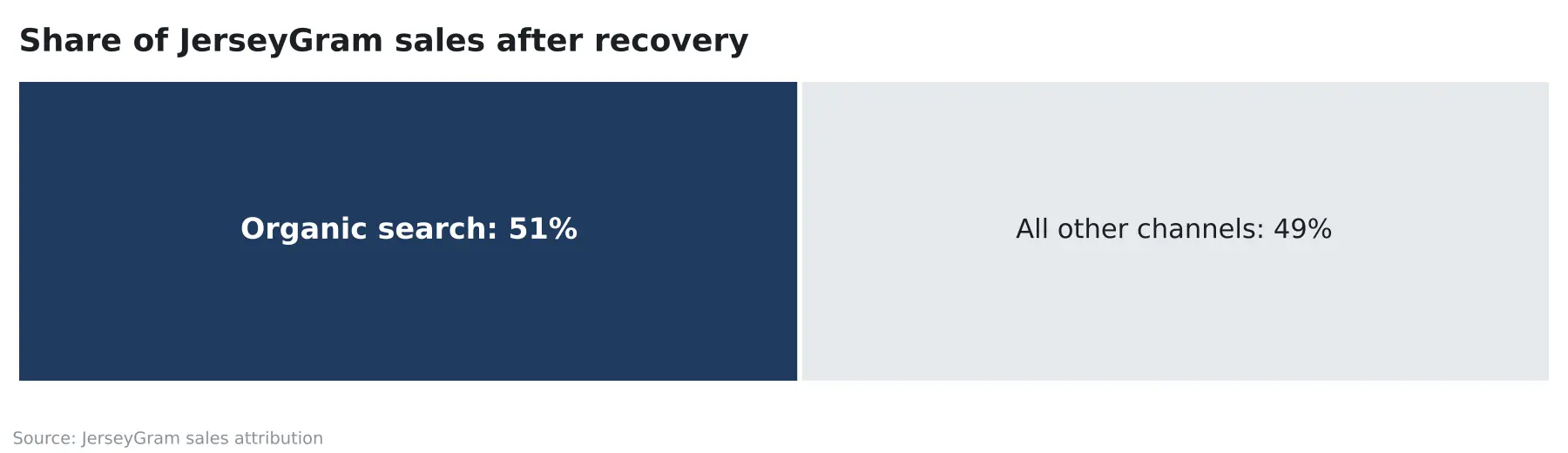
51%

Of all sales from organic search

Skills applied

SEO

Technical SEO

Penalty Recovery

Website Security

Conversion Rate Optimisation

Content Strategy

Frameworks

Disavow and Reconsideration

Search-Led Site Architecture

Core Web Vitals

JerseyGram share of sales by channel, with organic search at 51%
Share of JerseyGram sales by channel after the recovery.

The problem

JerseyGram sold authentic football jerseys online. Google search was its biggest sales channel.

Then, in 2021, hackers injected Japanese spam pages into the site. At the same time, thousands of spam links started pointing at it.

Google responded with a manual penalty. Organic traffic collapsed, and sales went with it.

The numbers

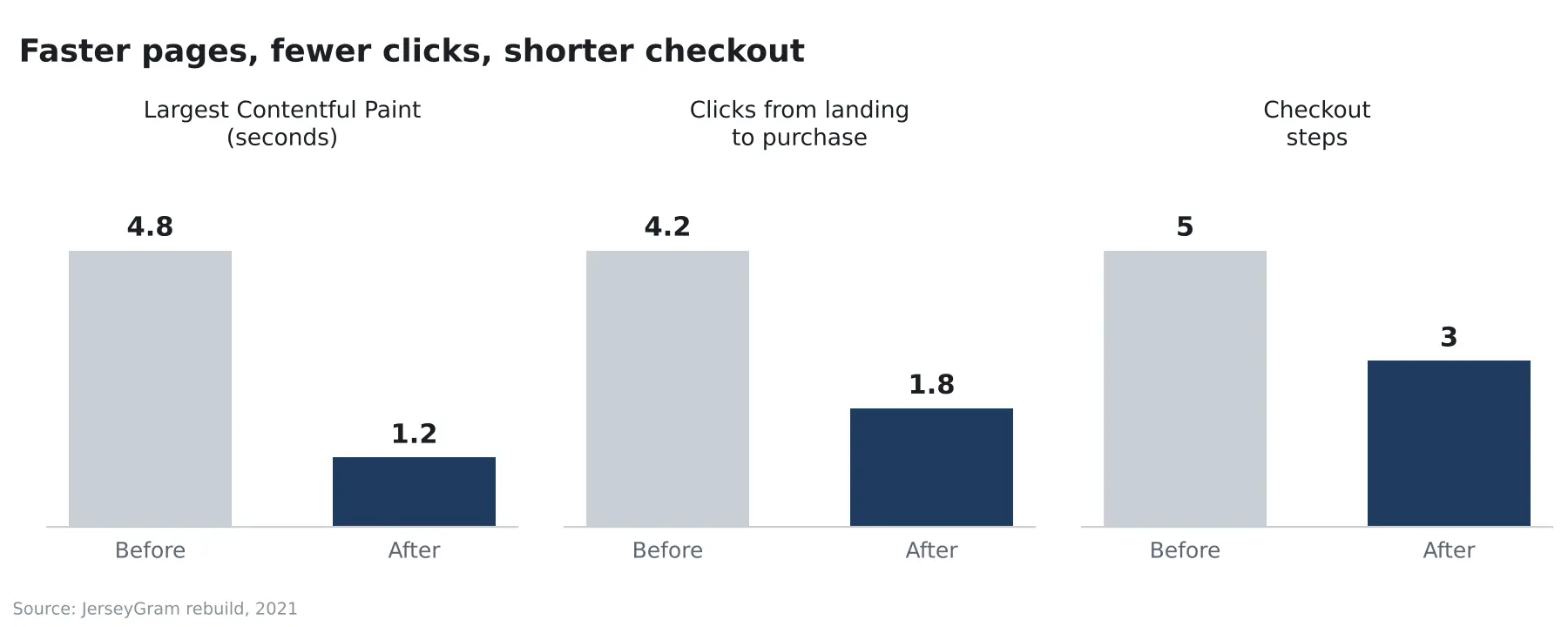
Beyond the headline results, the rebuild changed how the store performed for every shopper:

  • 1.2 seconds Largest Contentful Paint, down from 4.8
  • 1.8 clicks from landing to purchase, down from 4.2
  • Three steps at checkout, down from five

Two years after the work, organic search was still JerseyGram’s biggest revenue channel. The site kept ranking for thousands of football jersey keywords.

Two domains, one recovery

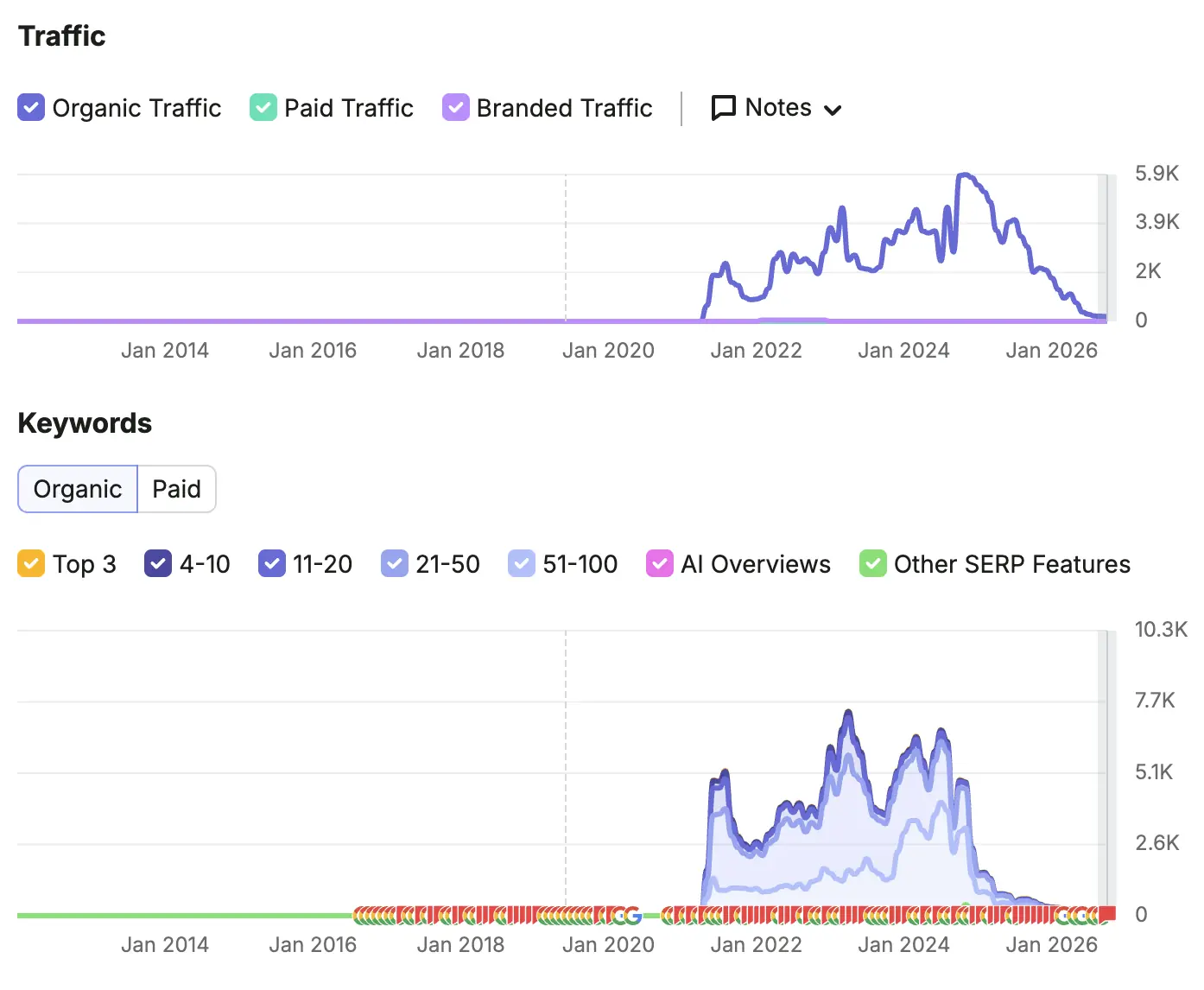
Semrush’s organic traffic estimates show the recovery more clearly than any single number: the old domain faded away, and the new one took over and kept climbing.

The old domain, jerseygramm.com, grew through 2019 and peaked at about 2,300 estimated monthly organic visits in mid-2020. In late 2019, Semrush also recorded a brief spike to about 73,100 ranking keywords, far more than a jersey store’s catalogue could account for. By early 2021, its organic traffic had fallen to almost nothing.
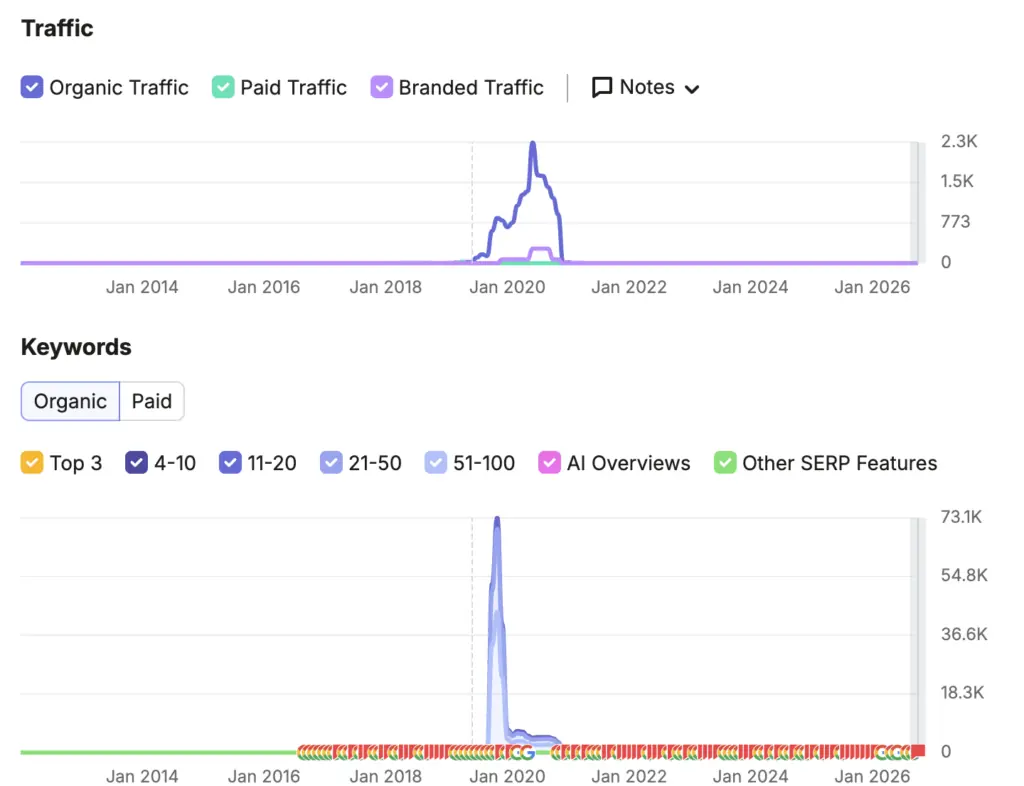
The old domain, jerseygramm.com: estimated organic traffic and ranking keywords. Source: Semrush, all time to October 2026.

After the move and the 301 redirects, jerseygram.com started from zero in the first half of 2021 and climbed for more than three years. Semrush estimates its organic traffic peaked at about 5,900 monthly visits in late 2024, with ranking keywords reaching about 7,400 at their high point in 2023.

That peak is more than two and a half times the old domain’s best month, and it was built on keywords that matched what the store actually sold. Semrush figures are third-party estimates, not the store’s own analytics, so read them as the shape of the story rather than exact counts.
Semrush organic traffic and keywords for the new jerseygram.com domain
The new domain, jerseygram.com: estimated organic traffic and ranking keywords. Source: Semrush, all time to October 2026.

A 72-hour audit

We started with a full security and SEO audit, finished in 72 hours. Here’s what we found.
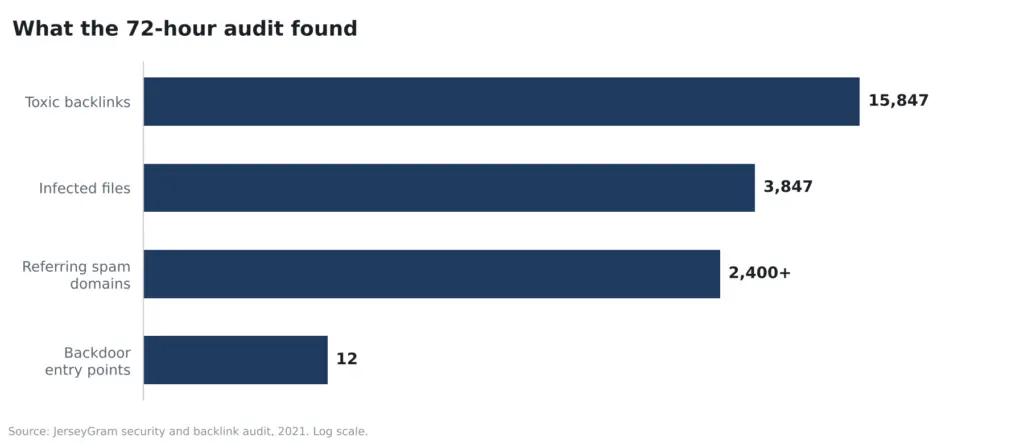
  • Malware: 3,847 files infected by the Japanese keyword hack.
  • Backdoors: 12 entry points that let the malware come back.
  • Spam links: 15,847 toxic backlinks from gambling, pharmaceutical, and adult sites.
  • Mobile: no mobile optimisation, though 68% of traffic was mobile.
  • Structure: a flat site with no real category hierarchy.
  • Duplication: duplicate content on 40% of product pages.
The scale of the problem, on a log scale.

Locking the doors first

There’s no point removing a penalty if the hackers can get back in. So security came first.

We removed all the malware code and closed every backdoor. We hardened the server and changed every password and access key. Then we set up automated malware scans and round-the-clock monitoring.

Getting the penalty lifted

With the site clean, we turned to the links. We reviewed 15,847 toxic links from over 2,400 domains.

Our disavow file covered 92% of the harmful links. We then sent Google a detailed reconsideration request, with evidence of every fix.

We also moved the store from jerseygramm.com to jerseygram.com. Every URL got a 301 redirect, and we fixed crawl errors and redirect chains as they surfaced.

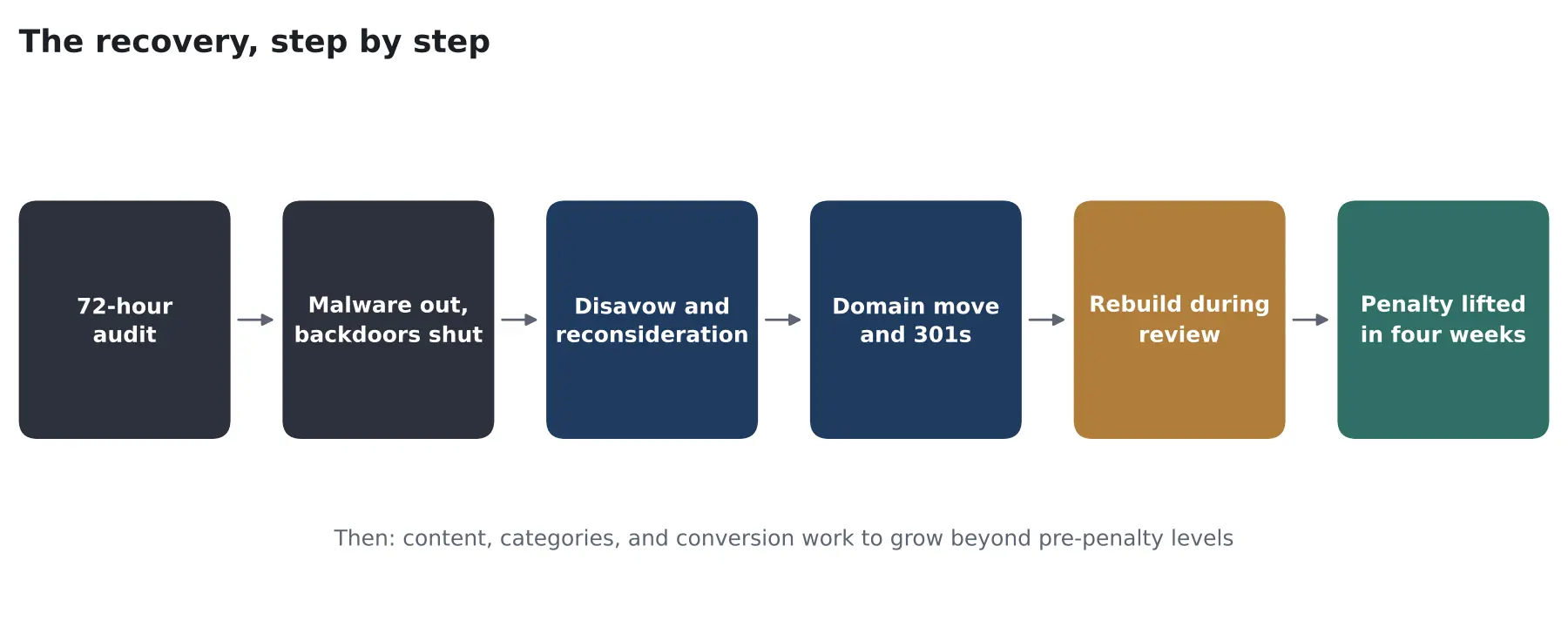
Google lifted the manual penalty within four weeks.
JerseyGram Google penalty recovery steps from audit to penalty lifted
The recovery sequence, from audit to penalty lifted.

Rebuilding the store during the review

We didn’t wait for Google’s answer. While the review ran, we rebuilt the site.

We created over 50 main categories based on how fans search. Subcategories covered club jerseys, national teams, basketball, women’s, kids’, retro, tracksuits, and custom kits.

Faceted search let shoppers filter by team, player, size, and season. Average clicks to purchase fell from 4.2 to 1.8.

Technical and on-page fixes

Largest Contentful Paint dropped from 4.8 seconds to 1.2 seconds, helped by lazy loading and WebP images.

We added schema for products, reviews, and breadcrumbs, and built XML sitemaps. Internal links pointed at the pages that make money.

We rewrote over 340 product descriptions and gave every page a unique meta title and description. Category pages got FAQ sections. Trust signals appeared across the site: secure checkout, authenticity guarantees, and customer reviews.

Making it easier to buy

Product pages got sharper photos, size guides, and previews of custom names and numbers.

Checkout went from five steps to three. Exit-intent pop-ups offered a discount to shoppers about to leave. On mobile, we moved key buttons within easy reach of the thumb.

Content for long-term growth

We mapped over 280 high-intent keywords across club and national team jerseys.

Category briefs targeted searches like “buy [team] jersey Nigeria”. Long-tail pages went after terms like “authentic Manchester United jersey Lagos”, and we built location pages.

Buying guides covered how to spot a fake jersey and how to pick your size. A blog tracked football news and kit releases. Comparison pages explained home versus away kits, and fan versus player editions.

What I learnt

  • Secure before you recover. Removing malware without closing the backdoors just invites the next infection.
  • Show Google your evidence. A reconsideration request lands better with proof of every fix.
  • Use the waiting time. Rebuilding during the review meant the site came back stronger, not just penalty-free.
  • Let search shape structure. Categories built around how fans search gave every team and kit a page to rank.
  • Speed and fewer steps sell. Faster pages and a shorter checkout turned recovered traffic into orders.
  • Organic compounds. Two years on, search was still the biggest revenue channel.
JerseyGram page speed, clicks to purchase and checkout steps before and after
The rebuild in numbers: speed, clicks to purchase, and checkout steps, before and after.

A penalty doesn’t have to be the end.

A penalty, a hack, or a sudden traffic drop can feel like the end. It doesn’t have to be. Seeing something similar on your site? Get in touch, and let’s take a look together.

More case studies