Search “best project management software” and count how many results are written by companies that sell project management software. Then count how many of them put themselves in first place.
Every marketing team I talk to is asking the same question right now: should we do it too? AI assistants lean heavily on “best of” lists when someone asks for a recommendation, so a list on your own site, with you at the top, looks like an easy way in.
I’ve been on both sides of this. I’ve written editorial rules that put the brand first in its own listicles, and I’ve argued against doing it carelessly. In this article I’ll show you what the 2026 research actually says, where it went badly wrong for one well-known brand, and the approach I’d use today.
Quick answer: Rank yourself first only when you can prove it on published criteria, with honest trade-offs and a disclosure. Self-ranking lists often get cited by AI assistants, but the 2026 data shows they rarely get the publisher recommended, and doing it at scale has cost some brands most of their search traffic.
Why brands do it: the AI search case
The case is real, and it is worth stating fairly.
AI assistants read “best of” lists. When Ahrefs studied the sources behind ChatGPT’s answers, recently updated “best X” lists were the most prominent page type, including lists where the recommended brand ranked itself first.
They still get cited. Peec AI analysed 232,000 AI citations between December 2025 and February 2026 and found that roughly one in ten came from self-promotional listicles, with no sign of AI platforms filtering them out over the period. ChatGPT was the exception, citing them far less often than Google’s AI surfaces or Perplexity.
Your own list is the only one you control. You can’t decide who appears in a publisher’s roundup. You can decide who appears on your blog. If an AI assistant retrieves your page, your brand is guaranteed to be in the source.
That is why so many SaaS companies publish them. The question is what happens after the citation.
What the data says: cited is not the same as recommended
This is the part most teams miss. An AI answer can cite your page as a source and then recommend someone else.
Lily Ray tracked 100 B2B “best [category] software” queries in Google’s AI Overviews at three points between April and June 2026. When a brand’s own self-ranking list was cited, that brand was left out of the recommendation about 69% of the time. The brands that did get recommended had far more referring domains and far more independent mentions.
Scrunch looked across seven AI surfaces, including ChatGPT, Claude, Gemini and Google’s AI Overviews. When a self-ranking list was cited, the publisher’s recommendation rate rose from about 4% to about 7%. Being named at all roughly doubled, from about 19% to 39%. But in most answers that cited a listicle, the assistant recommended nobody. It used the list as raw material for a neutral overview.
Ahrefs ran its own experiment, publishing 34 self-promotional pages for two of its products. The pages helped a new, little-known brand get mentioned far more than they helped an established one, and getting cited often did not lead to getting recommended.
| Study | What it measured | Main finding |
|---|---|---|
| Peec AI, Dec 2025 to Feb 2026 | 232,000 citations across six AI platforms | About 1 in 10 citations came from self-promotional lists; no filtering over time |
| Lily Ray, Apr to Jun 2026 | 100 B2B “best” queries in AI Overviews | Publisher left out of the recommendation about 69% of the time when its own list was cited |
| Scrunch, May to Jun 2026 | About 10,000 cited URLs across seven AI surfaces | Recommendation rate rose from about 4% to 7%; mentions roughly doubled |
| Ahrefs experiment, Feb to May 2026 | 34 self-promotional pages, four AI assistants | Helped a new brand most; citations often did not become recommendations |
Key takeaway
A self-ranking list can get your brand mentioned. It rarely gets your brand recommended. Recommendations follow what the rest of the web says about you: independent reviews, coverage and other people’s lists.
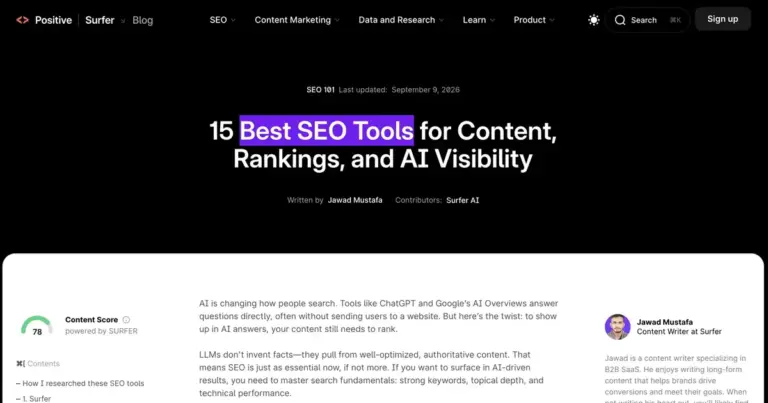
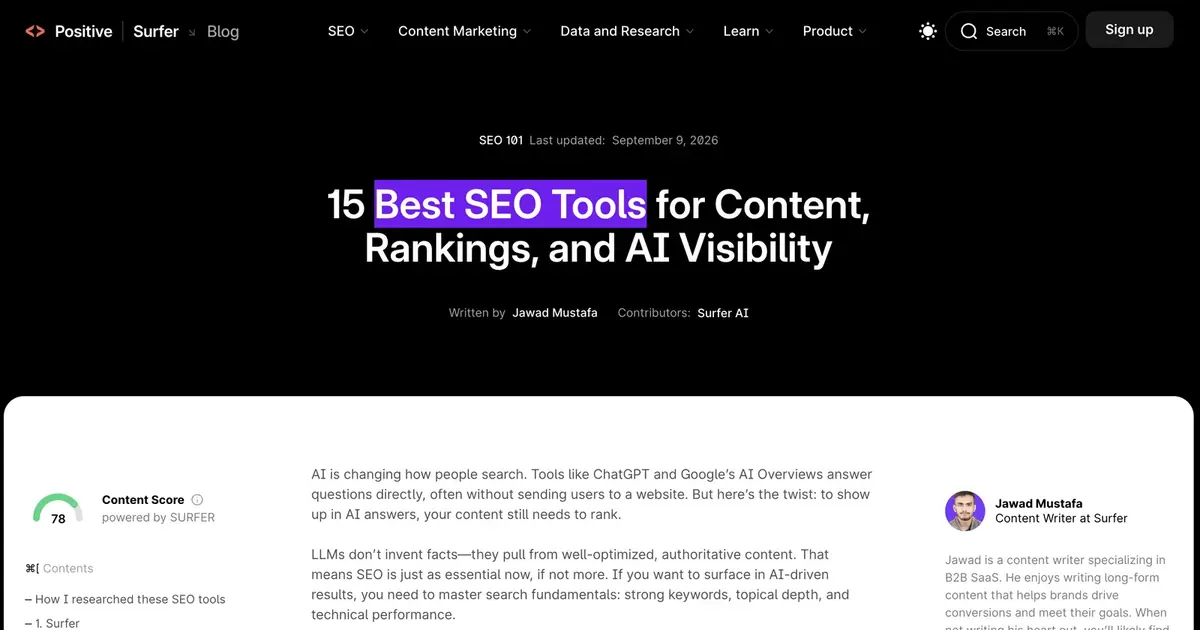
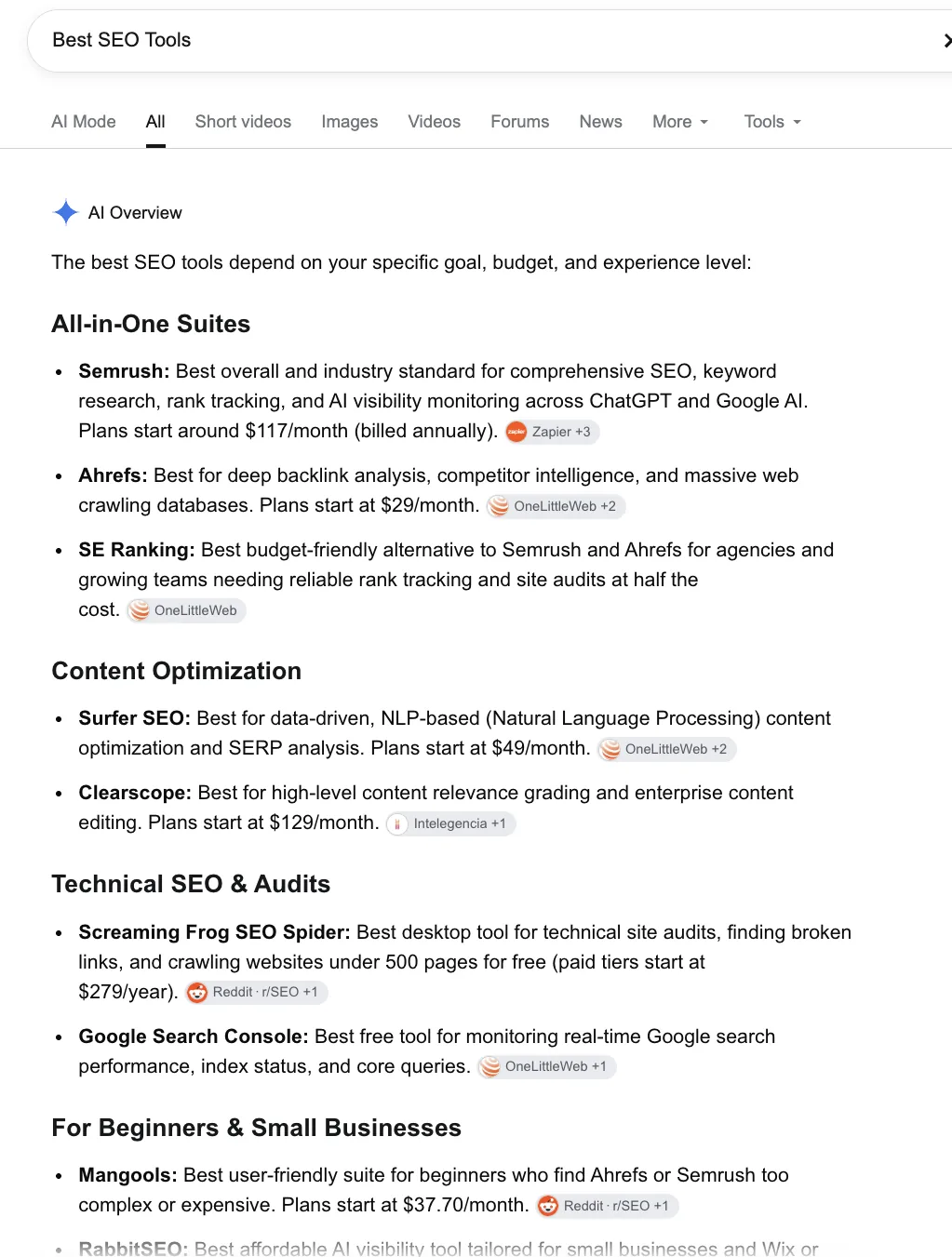
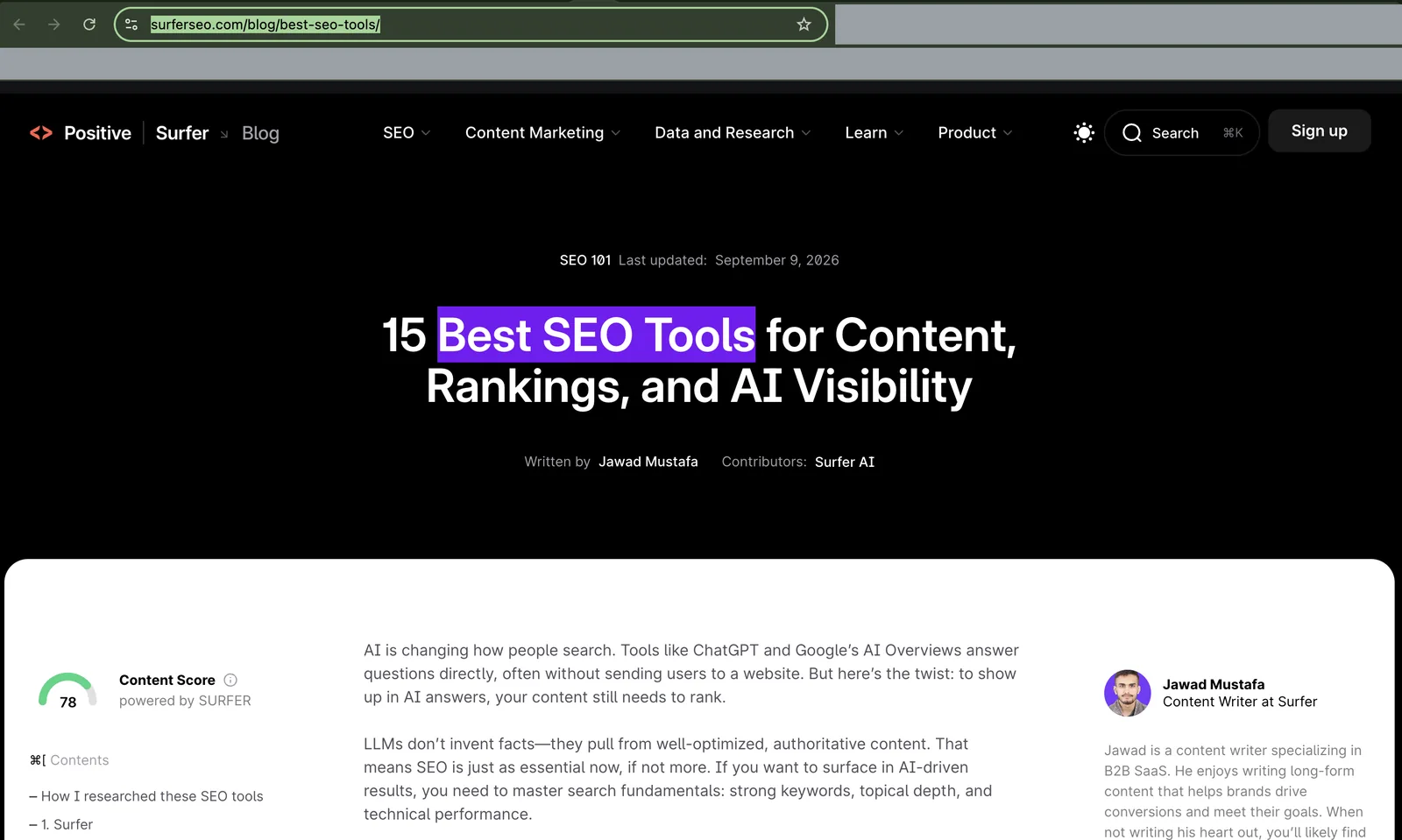
I tested this myself. Surfer’s guide to the 15 best SEO tools, last updated on 9 September 2026, puts Surfer in first place. When I searched “best SEO tools” on Google on 12 October 2026, the AI Overview led with Semrush, Ahrefs and SE Ranking. Surfer did appear, further down under content optimisation. But the visible source links pointed to Zapier, OneLittleWeb, Intelegencia and Reddit. Surfer’s own list was not among them.
In other words, Surfer’s mention came from what other sites say about Surfer, not from the list where Surfer ranks itself first.
Where it backfires
At scale, it can sink a blog. The clearest warning is ClickUp. Its blog lost 97.6% of its traffic from peak while carrying 249 competitor-alternatives listicles, every one of them ranking ClickUp first. Self-ranking lists were not the only issue on those sites, but they were part of a pattern of scaled, templated pages that Google started demoting from January 2026.
Google now applies its spam rules to AI answers. On 15 May 2026, Google extended its spam policies to AI Overviews and AI Mode, including scaled content abuse. A factory of near-identical “best X” pages is exactly what those policies describe.
Google’s review guidance rewards evidence, not claims. Google’s guidance on writing high-quality reviews asks for first-hand evidence, clear comparisons and honest pros and cons. A list that puts its publisher first with no method and no trade-offs fails every one of those tests.
Readers can tell. A list that crowns its publisher with no method reads like an advert. People leave, and they trust the rest of your content less.
Regulated industries carry legal risk. In finance, health and insurance, comparative claims usually need to be fair, accurate and backed by evidence. In the UK, for example, financial promotions must be fair, clear and not misleading. “We are the best” with nothing behind it is a compliance problem, not just an SEO one.
To be fair to the other side: the picture is not all bad. Kevin Indig’s analysis of millions of search results found that most vendor listicles actually gained traffic after January 2026. The ones that got hurt tended to be on sites doing it at scale, with thin, templated content. Quality and volume decide the outcome, not the format alone.
The middle path: be first only where you can prove it
The real question is not “should we be first?” It is “could we defend being first, in public, to a sceptical reader?” Here is the approach I recommend.
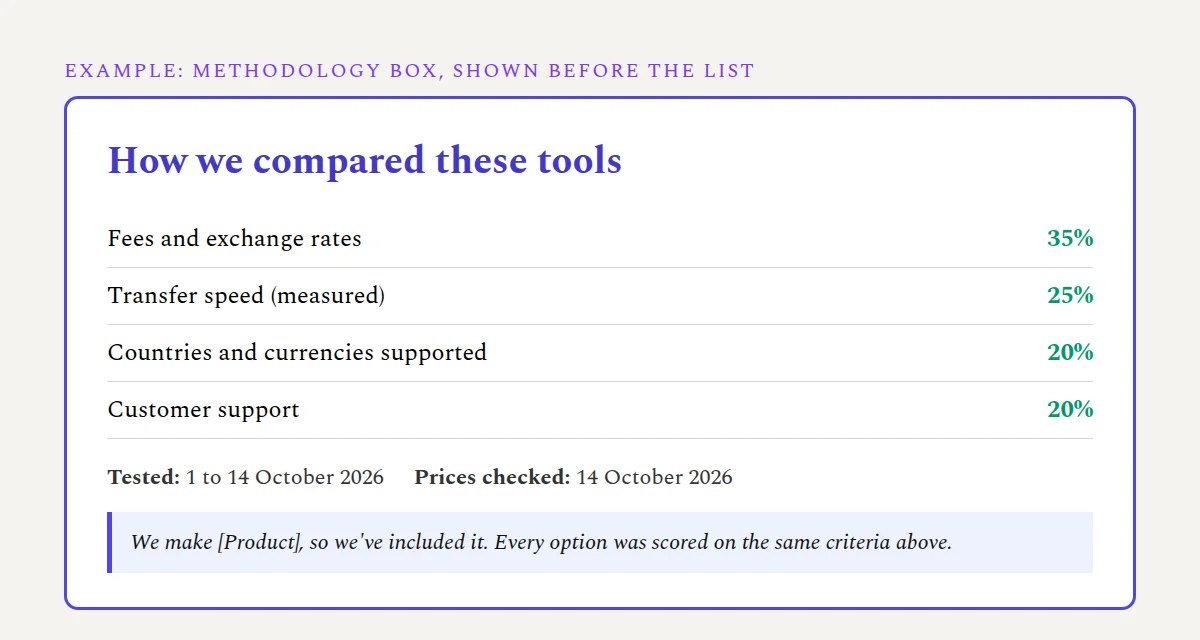
- Publish your criteria before the list. Say what you judged and how: fees, speed, coverage, support, features. Weight them if you can.
- Rank by the criteria, not by preference. If you score highest on the stated criteria for the stated audience, first place is earned. If you don’t, don’t put yourself first.
- Use “best for” labels instead of one ranking. “Best for freelancers paid in USD.” “Best for large business transfers.” It is more useful, more honest, and still lets you lead where you really do win.
- Show where competitors win. Every honest comparison has scenarios where another option is better. Saying so is the strongest trust signal on the page.
- Add first-hand evidence. Screenshots of real tests, measured transfer times, dated fee quotes. This is what separates a comparison from a sales page.
- Disclose the obvious. One line: “We make [Product], so we’ve included it. Here is how we compared every option.”
- Keep it current. Date the page and update it when prices or features change. An outdated comparison is unfair and, in regulated markets, a risk.
A quick decision framework
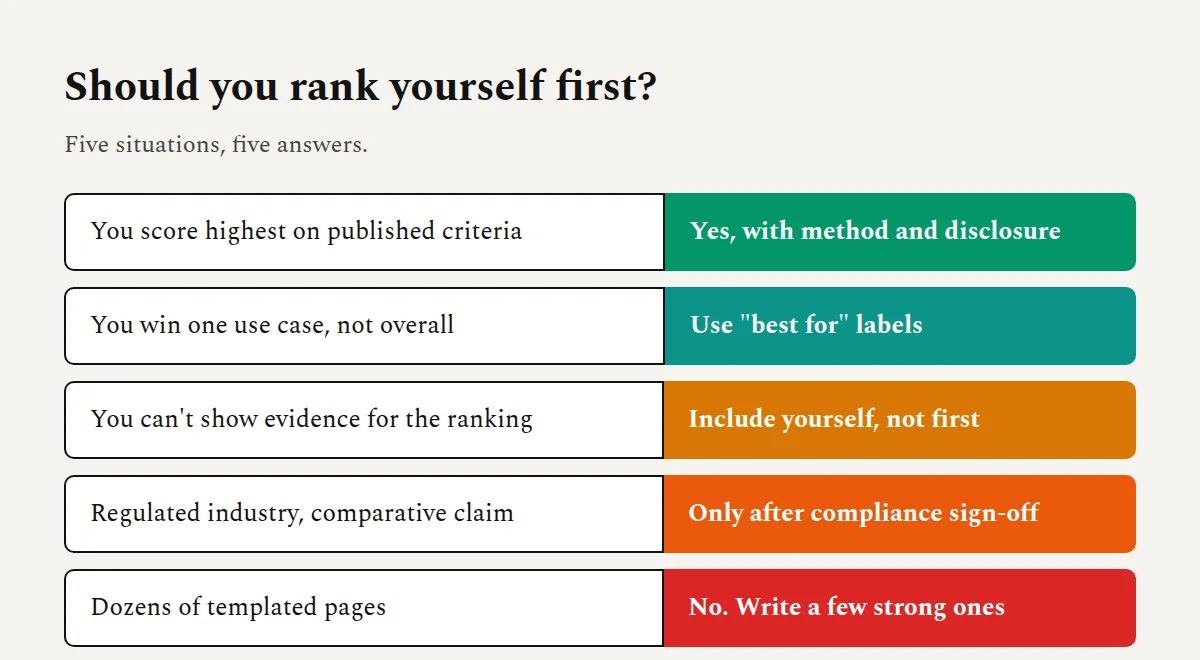
| Your situation | Rank yourself first? |
|---|---|
| You score highest on published criteria for the stated audience | Yes, with the method and a disclosure |
| You are best for one use case but not overall | Use “best for” labels and lead in your use case |
| You can’t show evidence for the ranking | No. Include yourself, but don’t claim first place |
| Regulated industry and the claim is comparative | Only after legal or compliance sign-off |
| You plan to repeat it across dozens of templated pages | No. Write a few strong comparisons instead |
Technical notes for comparison pages
- Answer first. Give the short answer in the first paragraph: who is best for whom, in one or two sentences. That is the part AI assistants lift.
- Schema. ItemList works for ranked lists. Decide your policy on item URLs when the list includes direct competitors.
- Linking. Many brands don’t link to competitors. That is a fair commercial choice, but the facts about each competitor still need to be accurate and dated.
- One strong page per comparison. Several near-identical comparison pages compete with each other and look like a pattern.
Before you publish any comparison, check what AI assistants already say about you for that category. The Competitor and Discovery prompts in my AI visibility audit template are built for exactly this.
My view
Rank yourself first when you can prove it, and make the proof visible. Where you can’t, include yourself fairly and lead with the use case you are actually best at.
The brands that win AI recommendations don’t just appear on their own lists. They appear on everyone else’s. Your own listicle is a supporting signal at best. Third-party consensus does the heavy lifting, which is why your help centre, your review profiles and your coverage matter more than one more “best of” post.
“Calling yourself the best is easy. Getting the rest of the web to agree is the work.”
Afeez Adebayo
Find out if AI recommends you, or just cites you
The free AI visibility audit template tracks mentions, citations and accuracy across ChatGPT, Perplexity, Gemini and Google AI.
If you want a second opinion on your comparison pages, get in touch.