Every SEO lead has been in this meeting. You present a chart of rankings going up. Someone senior asks, “So what does that mean for the business?” And the room goes quiet.
The problem isn’t the work. It is the translation. SEO goals written in SEO language don’t connect to the numbers leadership is judged on: customers, revenue, retention, new markets. So good SEO work gets underfunded, and SEO teams get judged on charts nobody upstairs cares about.
The fix is to start from the company’s number and work backwards, so every SEO objective, workstream and report traces back to it. This guide shows you how, step by step, with a free worksheet that does the maths.
Quick answer: To tie SEO to company goals, start with the number leadership is judged on, agree organic search’s share of it, then work backwards to the sign-ups, conversion rate and traffic SEO must deliver. Separate branded from non-branded search, map every workstream to an objective, and report monthly in business terms.
Step 1: Start with the company goal, in its own units
Ask leadership one question: what number is the company judged on this year? It is usually one of these:
- New customers or sign-ups
- Revenue or transaction volume
- Activation or retention
- Expansion into new markets
Get the exact target and the date. “Grow” is not a goal. “200,000 sign-ups a month by the end of Q4” is.
Step 2: Work out what organic search must contribute
Next, agree organic search’s share of that goal. This is a conversation, not a calculation you do alone. Leadership may already expect a figure, and finance may already have one in the plan.
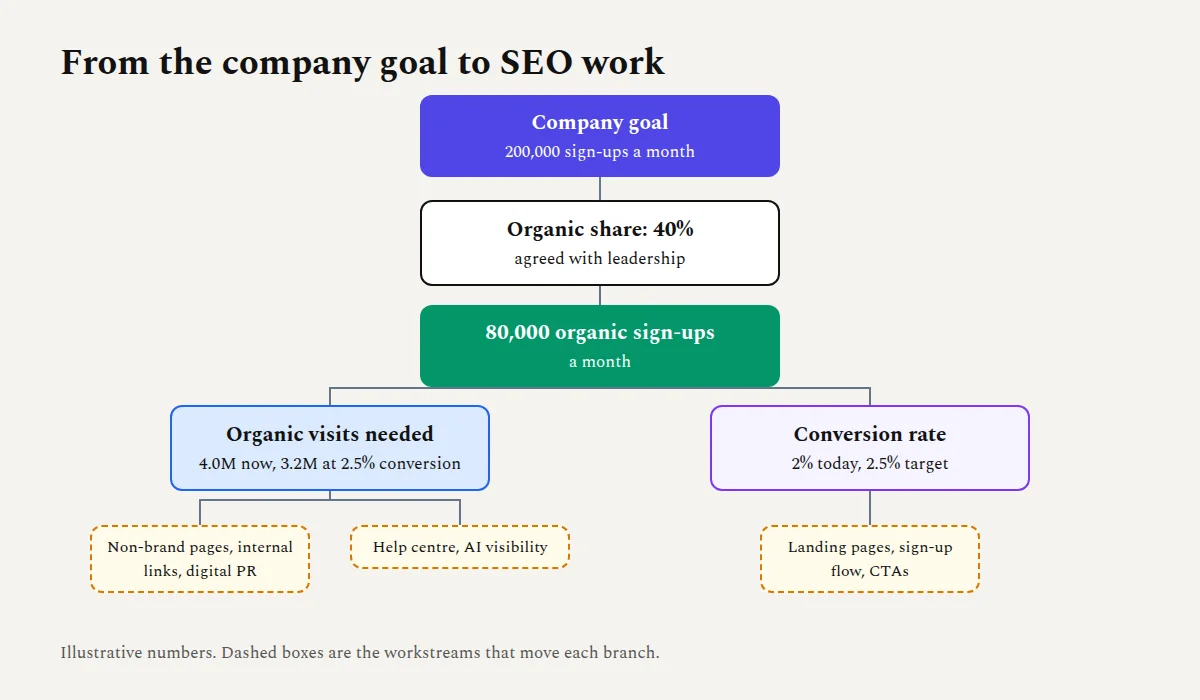
Then work backwards. Here is a worked example with illustrative numbers:
| Line | Example |
|---|---|
| Company goal | 200,000 sign-ups a month |
| Organic share expected | 40% |
| Organic sign-ups needed | 80,000 a month |
| Organic visit-to-sign-up rate | 2% |
| Organic visits needed | 4,000,000 a month |
| Current organic visits | 1,500,000 a month |
| Gap | 2,500,000 visits a month |
Now you have a traffic gap, and a conversion rate you can work on too. That second lever is often the cheaper one. In the same example, lifting the organic conversion rate from 2% to 2.5% cuts the traffic you need from 4 million visits to 3.2 million, and the gap from 2.5 million to 1.7 million.
The cheapest growth is often conversion
A half-point lift in conversion did the work of 800,000 extra visits a month in this example. Before you promise leadership more traffic, check how much the traffic you already have could convert.
Step 3: Split brand from non-brand
This is the step most SEO plans skip, and it changes everything.
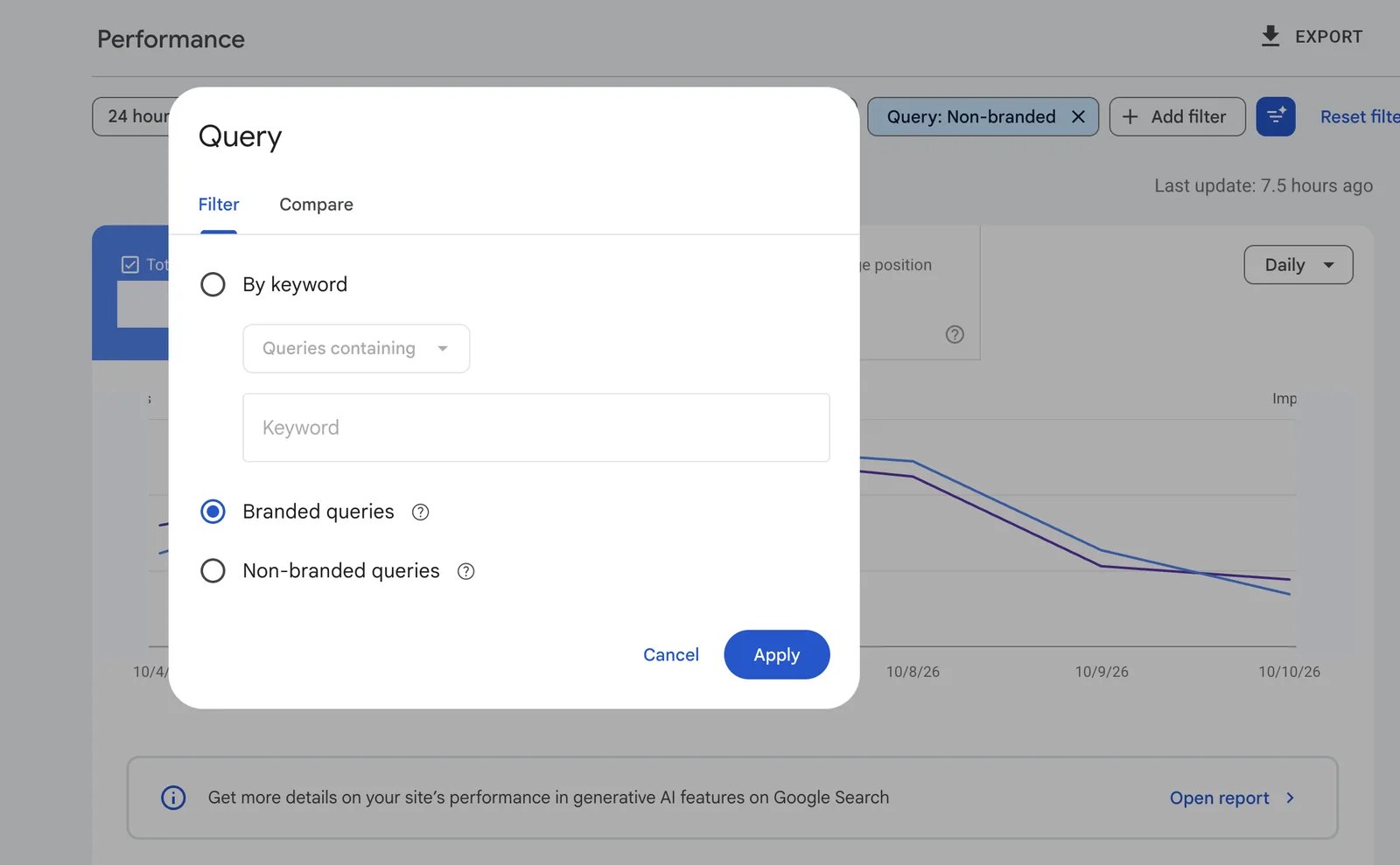
Branded search, people typing your company’s name, is mostly created by other things: advertising, PR, word of mouth and the product itself. SEO protects it but rarely creates it. Non-branded search, people searching for the problem you solve, is where SEO creates new demand. So set a separate target for it, for example the share of organic sign-ups that should come from non-branded searches.
This also protects you. If a big ad campaign lifts branded traffic, SEO doesn’t take false credit. If the ad budget is cut and branded traffic falls, SEO doesn’t take false blame.
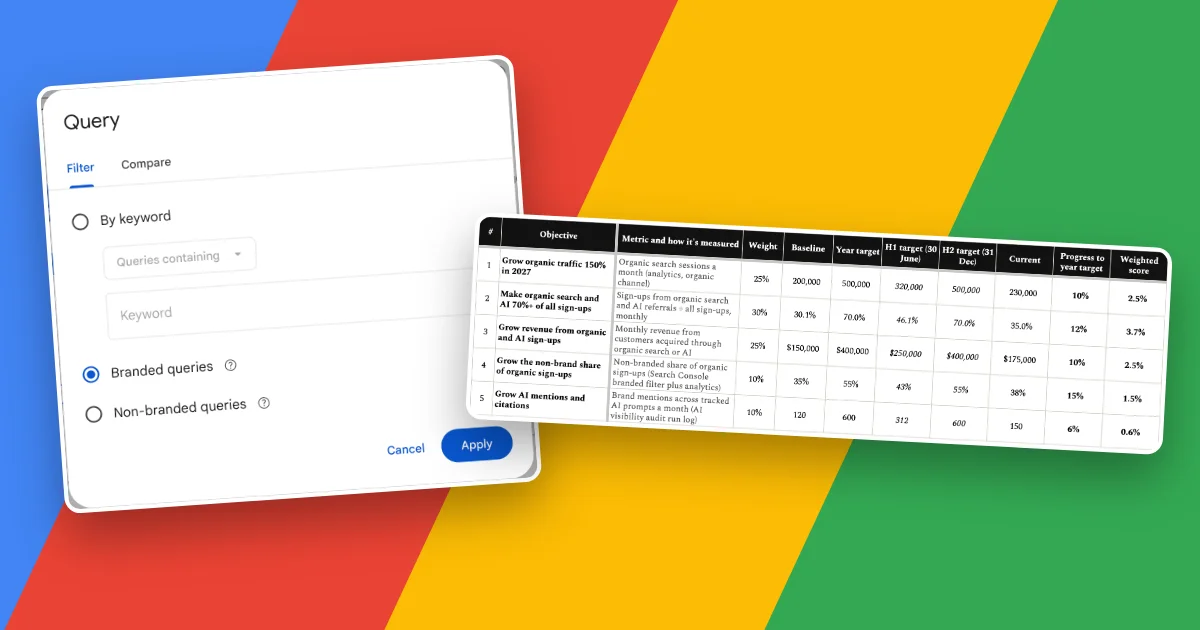
It is far easier to measure than it used to be. Google added a branded queries filter to Search Console in November 2025, and rolled it out to all eligible sites in March 2026. It splits the Performance report into branded and non-branded queries automatically, without the regex workarounds teams used before. Search Console Insights also shows the split as a single card.
Step 4: Add AI visibility as a goal
More buyers now ask AI assistants before they search. AI answers send fewer clicks, but the brands they mention shape who people choose. So add an AI visibility objective alongside traffic: mentions and citations of your brand in ChatGPT, Perplexity, Gemini and Google’s AI features, measured against a baseline.
Be honest that the link from an AI mention to a sign-up is harder to measure. Report it as a leading indicator, not a revenue figure. My AI visibility audit template gives you the baseline to measure against.
Step 5: Build a weighted objectives scorecard
Turn the gap into three to six objectives. Leadership signs off on targets, not activities, so give every objective the same six things: a weight, a baseline, a year target, and targets for each half of the year.
| Objective | Weight | Baseline | Year target | H1 target | H2 target |
|---|---|---|---|---|---|
| Grow organic traffic 150% in 2027 | 25% | 200,000 sessions a month | 500,000 | 320,000 | 500,000 |
| Make organic search and AI 70%+ of all sign-ups | 30% | 30% (25,000 of 83,000) | 70% | 46% | 70% |
| Grow revenue from organic and AI sign-ups | 25% | $150,000 a month | $400,000 | $250,000 | $400,000 |
| Grow the non-brand share of organic sign-ups | 10% | 35% | 55% | 43% | 55% |
| Grow AI mentions and citations | 10% | 120 a month | 600 | 312 | 600 |
Illustrative numbers.
Three rules make the scorecard work:
- Weight by business value, not by effort. Sign-ups and revenue should carry more weight than traffic. Traffic is a means, not the end.
- Back-load the H1 target. SEO compounds, so most of the gain usually lands in the second half. Setting H1 at around 40% of the gap is more honest than splitting it 50/50, and it saves an awkward mid-year review.
- Keep weights at 100%. Then one overall score tells leadership how the whole programme is doing in a single number.
Organic and AI together
Counting organic search and AI referrals as one share of sign-ups reflects how people now find you: some search, some ask an assistant, many do both. It also stops a rise in one channel looking like a loss in the other.
The worksheet’s scorecard calculates the H1 target, progress against the year target, each objective’s weighted score and a status based on how much of the year has passed. Update the “Current” column every month and the rest fills itself.
Step 6: Map every workstream to an objective
Now list your workstreams and show which objective each one moves. A typical plan looks like this:
| Workstream | Main objective it supports |
|---|---|
| Programmatic or template pages | Non-brand sign-ups |
| Help centre and resources | Non-brand sign-ups, AI visibility |
| Conversion improvement | Visit-to-sign-up rate |
| Internal linking | Non-brand sign-ups |
| Digital PR | AI visibility, non-brand sign-ups |
| Technical health | Protects every objective |
If a workstream doesn’t support an objective, question whether it belongs in the plan. And if an objective has no workstream behind it, it is a wish, not a goal.
Step 7: Agree what SEO does not own
SEO brings people to the site. It doesn’t control the sign-up flow, app store pages, pricing or product quality. Write down these dependencies and who owns each one. When conversion falls because of a product change, the report should say so clearly, before anyone assumes SEO broke something.
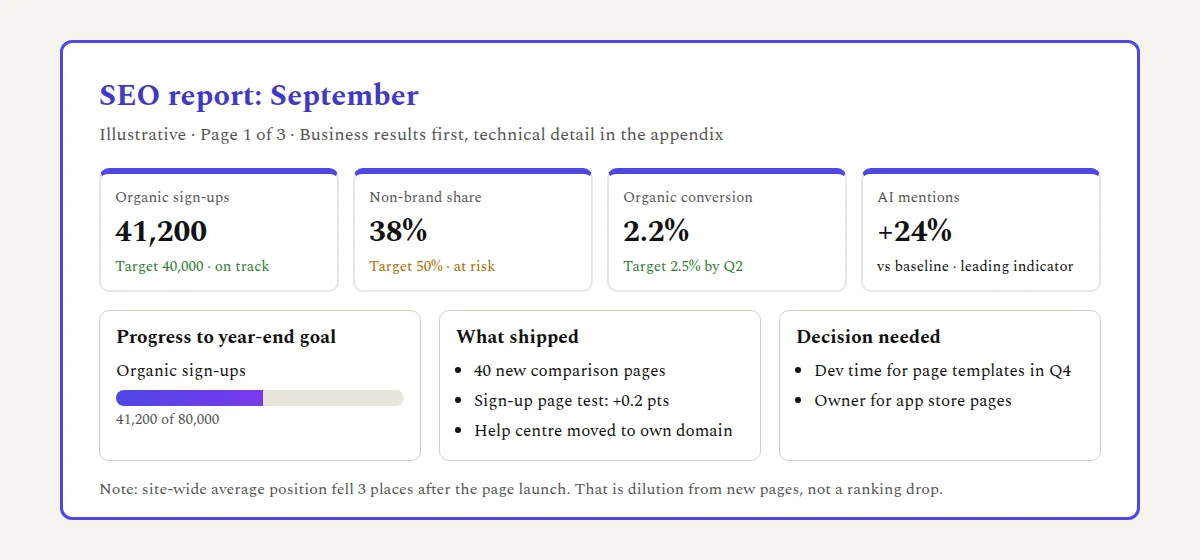
Step 8: Report in business language every month
A simple four-part monthly report works for most leadership teams:
- Performance. The scorecard: each objective against its H1 or H2 target, plus the overall weighted score.
- What shipped. What went live last month, with links. Not what was planned.
- Blockers and decisions. What is stuck, and the decision needed from leadership.
- Next month. What ships next, and which objective it moves.
Lead with the business number. Put rankings, crawl stats and technical metrics in an appendix for the people who need them.
Step 9: Explain metric quirks before someone else misreads them
Some SEO metrics move in ways that look bad but aren’t. Two come up constantly:
- Average position falls after a big launch. Hundreds of new pages start ranking low and pull the site-wide average down, even while impressions and clicks rise. It is dilution, not decline. I explain this in more detail in my guide to programmatic SEO.
- A market’s average position drops. The mix of queries changes, with more new, lower-ranking queries entering the data. Existing rankings haven’t moved. It is a composition effect.
Call these out in the report before anyone asks. It builds trust, and it stops good projects being cancelled for the wrong reasons.
Step 10: Re-forecast every quarter
Targets set in January are guesses by April. Every quarter, compare actuals with the plan, update the forecast and adjust the workstreams. Share the update with leadership, including what you are stopping and why. A plan that never changes is a plan nobody is reading.
“Leadership doesn’t need to understand SEO. SEO needs to speak in the numbers leadership already understands.”
Afeez Adebayo
Get the free SEO goal-setting worksheet
A weighted objectives scorecard with H1 and H2 targets, a driver tree calculator and a workstream map. Change the inputs and everything updates.
If you want help building an SEO plan leadership will back, get in touch.