Programmatic SEO has a bad reputation, and a lot of it is earned. Thousands of near-identical pages, built from public data, with a city name or a keyword swapped in. Google has spent years learning to ignore them, and AI answers now make most of them pointless.
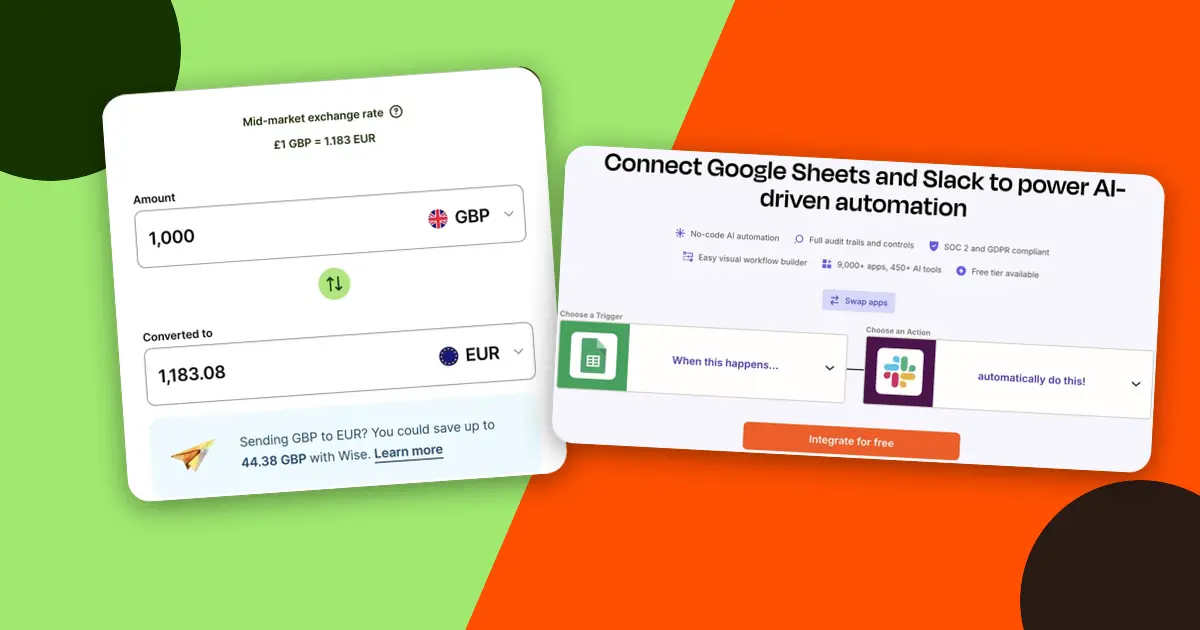
Yet some of the biggest organic traffic engines on the internet are programmatic. Wise has millions of currency converter pages. Zapier has hundreds of thousands of integration pages. Neither is spam.
So the method isn’t the problem. The idea is. In this guide I’ll give you the seven tests I use before building any programmatic page set, with real examples of ideas that worked and ideas that wiped a site out of Google. There’s a free scorecard to go with it.
Quick answer: A programmatic SEO idea is worth building when every page shows data you own, answers a question no other page on the site answers, describes something your product actually does and ends in a real next step. If anyone could build the same pages from public data, Google and AI assistants have no reason to prefer yours.
What separates Wise from the sites that got wiped
Start with two examples that sit at opposite ends.
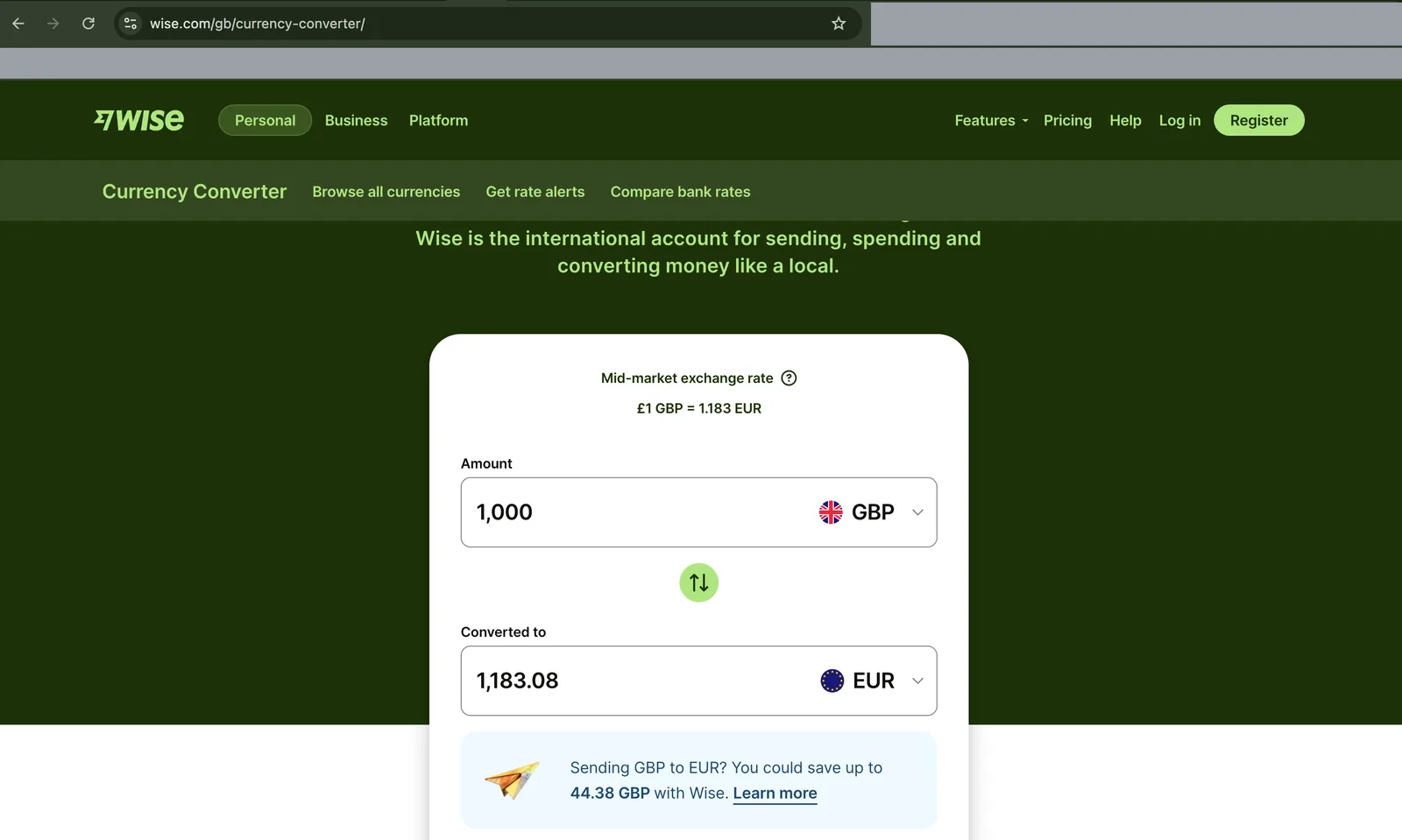
The ones that work. Backlinko counted around 8.5 million currency converter pages across Wise’s domain, and more than 590,000 integration pages on Zapier. Every Wise converter page shows the live exchange rate, a working converter and a nudge to send the money with Wise. Every Zapier page describes a connection Zapier actually supports and lets you build it. The template repeats. The data and the action are unique to the company.
The ones that didn’t. Causal, a finance software startup, used AI to copy a competitor’s sitemap and published around 1,800 articles at speed. Ahrefs describes how it lost hundreds of rankings and a large share of its traffic almost overnight once the story went public.
Tailride, a fintech tool, wrote openly about growing from 300 pages to over 22,000 in a few months, including thousands of SWIFT code pages and thousands of “what is” finance glossary pages. Its traffic dropped to zero, and within six months Google had gone from indexing more than 20,000 of its pages to just one.
Key takeaway
Notice that Wise has SWIFT code pages too, and Tailride’s were wiped. The page type alone doesn’t decide the outcome. What sits on each page, and whether the site behind it has a real product connected to that data, does.
Google’s own spam policy on scaled content abuse is clear that the problem is generating many pages mainly to manipulate rankings, without adding value, whatever tool produced them. The seven tests below are how I check for value before a single page is built.
Test 1: Does every page show data you own?
This is the most important test. A programmatic page earns its place when it shows first-party data: your prices, your rates, your availability, your coverage, your usage data.
- Pass: a converter page showing the live rate your product actually offers, pulled from your own system.
- Fail: a page for every bank’s SWIFT code, every competitor’s pricing or every finance term, copied from public sources.
If anyone could build the same page set from public data, assume someone already has, and that they have more authority than you.
Test 2: Does each URL answer a different question?
Keyword variants are not different pages. “Send money to Kenya” and “transfer money to Kenya” are one intent, so they need one page.
A page set passes when the answer actually changes from page to page. Converting US dollars to euros and converting pounds to euros involve different rates, fees and rules, so they deserve separate pages. Two wordings of the same question don’t.
Ask yourself: if I removed the variable from the title, would the rest of the page change? If not, it fails.
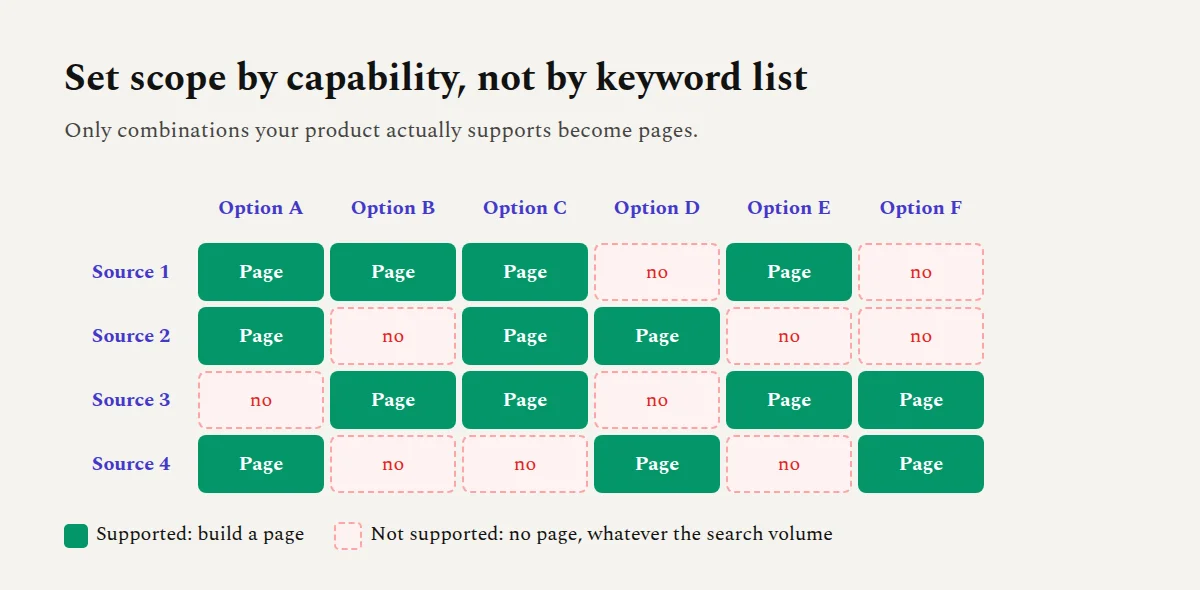
Test 3: Is the scope set by what your product really does?
The fastest way to build thin pages is to let a keyword list set the scope. Someone finds 10,000 keyword combinations and builds a page for each, including ones the product doesn’t support.
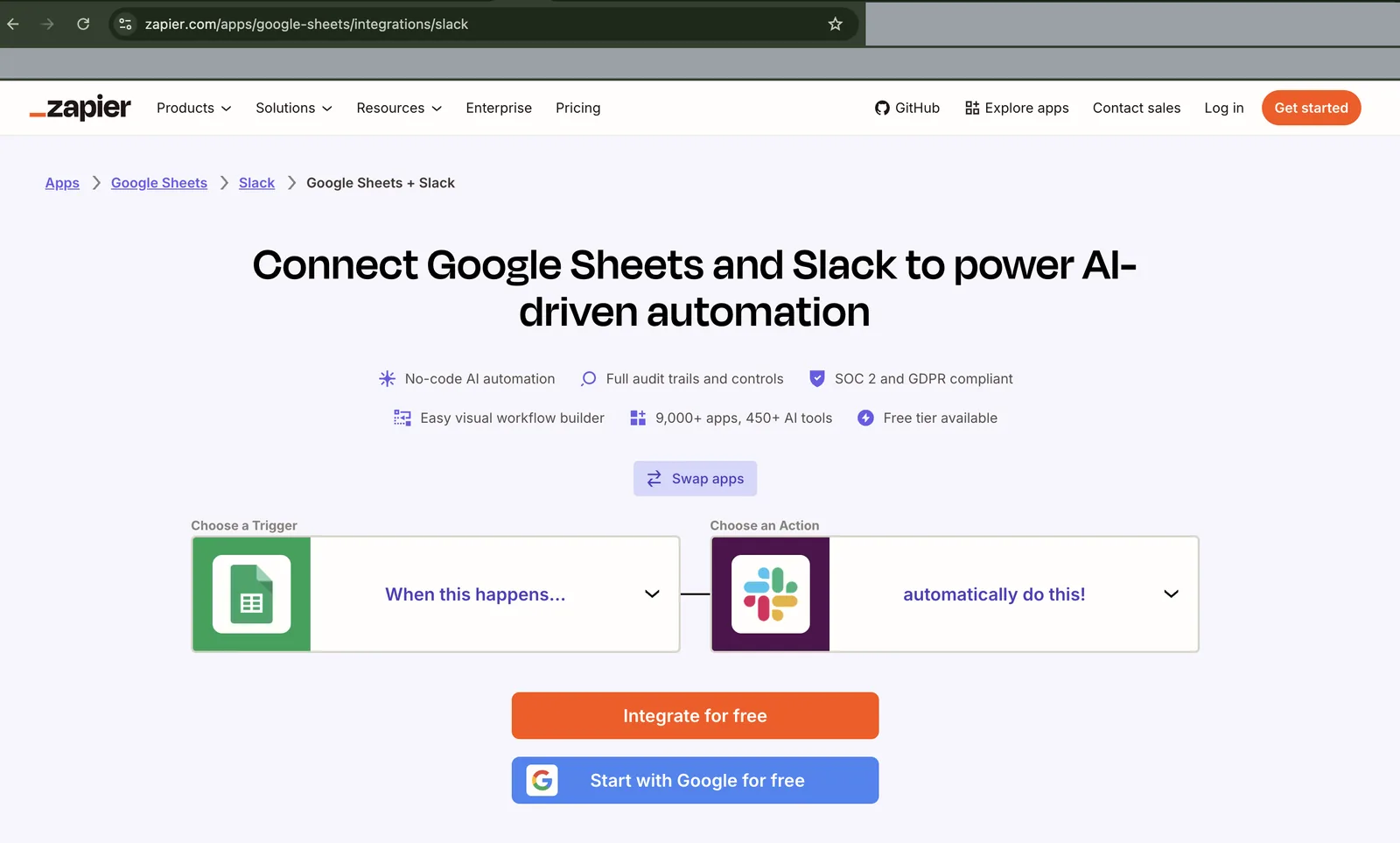
Set the scope by capability instead. Zapier builds pages for app connections Zapier actually offers, not every pair of app names people search for. List what your product can do, turn that into a grid, and let each filled cell become one page. Then prioritise by capability first and search volume second.
Test 4: Is there a real next step on every page?
A page that answers a question and then leaves the reader nowhere has weak business value. In AI search it is worse: the assistant gives the answer and nobody clicks.
Every programmatic page should end in a task the reader can complete with your product: send, convert, connect, sign up, apply, check eligibility. Wise’s converter pages point you straight into sending money. Zapier’s integration pages lead straight into building the connection. If a page topic has no credible product action, it probably doesn’t belong in the set.
Test 5: Can you keep it accurate at scale?
One wrong fee on one page is a typo. One wrong fee in a template is a wrong fee on every page.
Before building, answer four questions:
- Where does each data point come from, and how often does it change?
- Who updates it, and is the update automated?
- Can your CMS handle the volume? Check import limits, page limits and build times before page one, not at page 800.
- Who reviews it? Review the template once, thoroughly, with legal or compliance if your industry needs it. Then spot-check generated pages every month.
Test 6: Is your architecture ready?
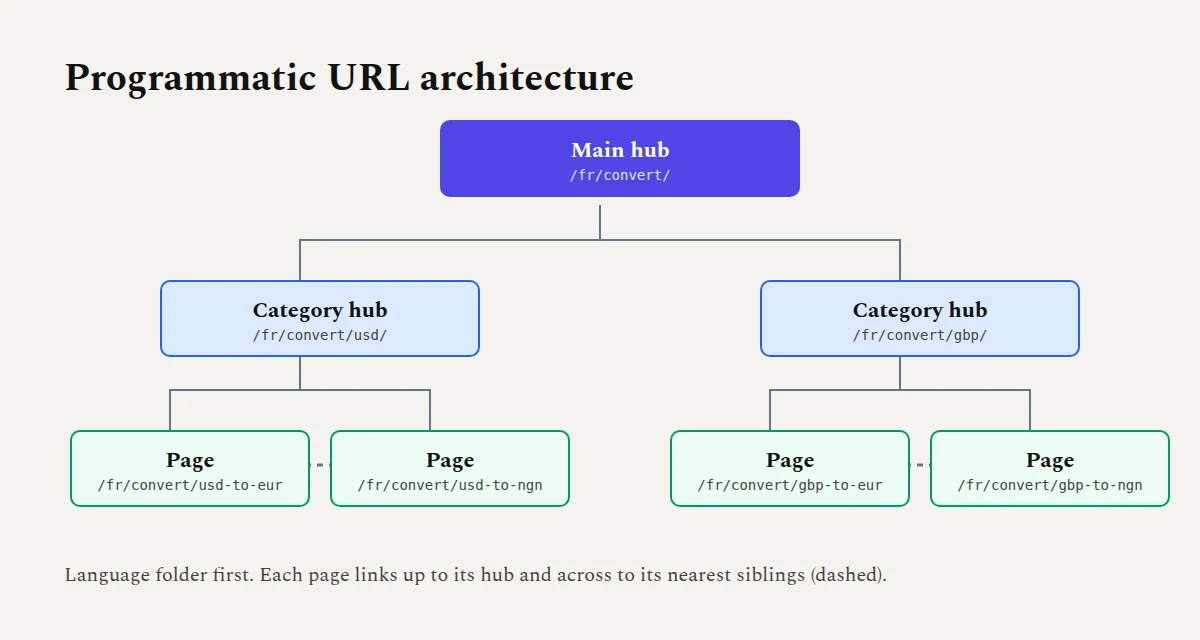
Programmatic pages multiply every technical decision, good or bad. Get these right in the template:
- URL pattern. Decide it once. If you will localise, put the language folder first: /fr/convert/usd-to-eur, not /convert/fr/usd-to-eur.
- Hub structure. A main hub, then category hubs, then individual pages, so every page is reachable within a few clicks.
- Internal links. Each page links up to its hub and across to its closest siblings.
- Hreflang. Define language clusters before you publish. Retrofitting hreflang across thousands of pages is painful.
- Schema. One validated schema pattern per template, generated for every page.
- Sitemaps. Split them by template so you can see indexation for each page type.
My technical SEO and international SEO pages go deeper on architecture and hreflang.
Test 7: Are you measuring it the right way?
This test is about reporting, and it catches more teams than the other six.
When you publish hundreds of new pages, your site’s average position in Search Console usually gets worse. New pages start ranking low, often on page three or four, and pull the site-wide average down. On paper it looks like a decline. In reality, impressions are rising and your existing pages haven’t lost anything.
If you don’t plan for this, someone will read it as failure and stop the project. So before launch:
- Report programmatic pages as their own segment, by URL folder.
- Track indexed pages, impressions, clicks and sign-ups for that segment, not site-wide average position.
- Give pages time. Publish early in a quarter so they can be crawled, indexed and start ranking before anyone judges them.
Start small
Launch your highest-priority segment first, often 50 to 200 pages. Check that they get indexed and that people use them before you scale to the full set. Tailride went from 300 pages to 22,000 in months. A slower start would have shown the problem early.
Score your idea
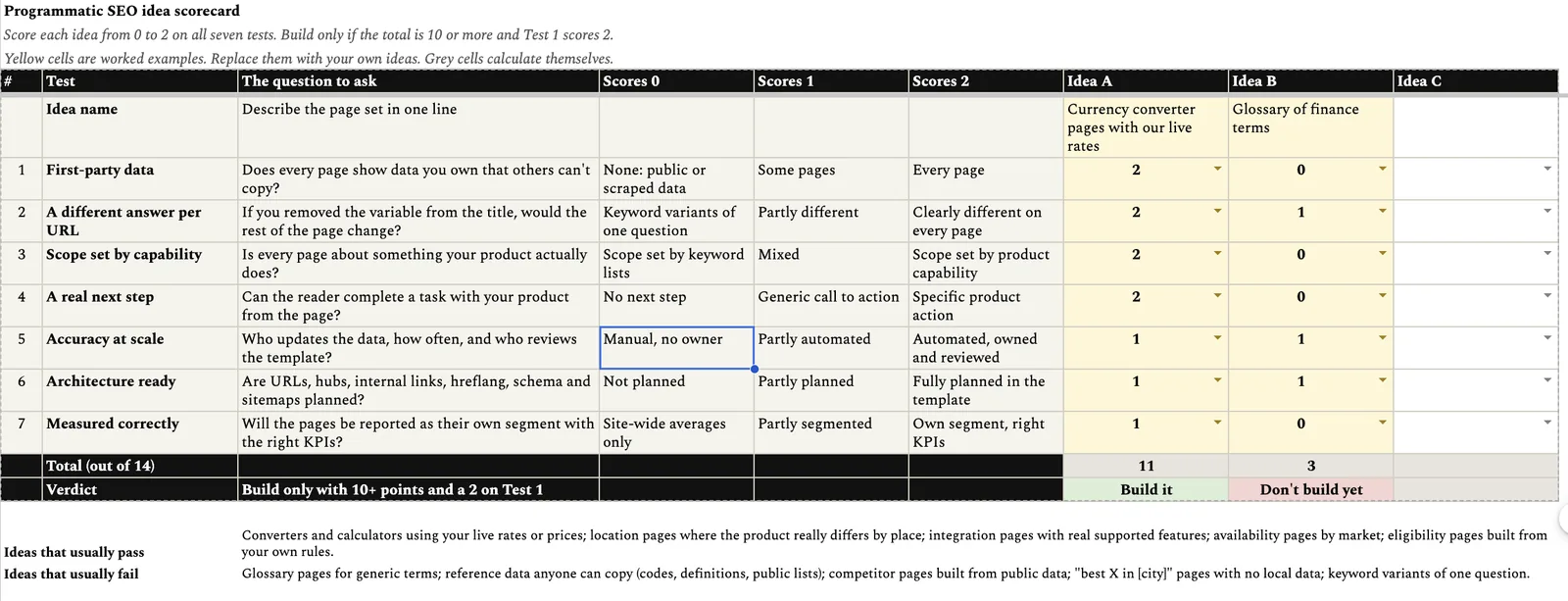
Score each test from 0 to 2. Build only if the total is 10 or more and Test 1 scores 2.
| Test | 0 | 1 | 2 |
|---|---|---|---|
| 1. First-party data | None | Some pages | Every page |
| 2. Different answer per URL | Keyword variants | Partly different | Clearly different |
| 3. Scope set by capability | Set by keywords | Mixed | Set by product |
| 4. Real next step | None | Generic CTA | Specific product action |
| 5. Accuracy at scale | Manual, no owner | Partly automated | Automated, owned, reviewed |
| 6. Architecture ready | Not planned | Partly planned | URLs, hubs, hreflang, schema set |
| 7. Measured correctly | Site-wide averages | Partly segmented | Own segment, right KPIs |
The free scorecard does the maths for you. Score up to three ideas side by side, and it gives each one a total and a verdict: build it, or don’t build yet.
Ideas that usually pass, and ideas that usually fail
Usually pass:
- Converters and calculators that use your live rates or prices
- Location or route pages where the product really differs by place
- Integration pages showing real supported features and setup steps
- Availability or status pages by market
- Eligibility pages built from your own rules
Usually fail:
- Glossary pages for generic terms
- Reference data anyone can copy: codes, definitions, public lists
- Competitor pricing or feature pages built from public data
- “Best X in [city]” pages with no local data
- Keyword variants that answer the same question
Many of the “usually fail” ideas are also the ones AI assistants can answer on their own, so they lose twice: weak rankings and no clicks. If you want to check how AI already treats your category, my AI visibility audit template is a good place to start.
“The template is never the problem. The data behind it is the whole point.”
Afeez Adebayo
Get the free programmatic SEO scorecard
Seven tests, three ideas side by side, an automatic total and a build-or-don’t verdict.
If you’re planning a programmatic build and want a second opinion before page one, get in touch.