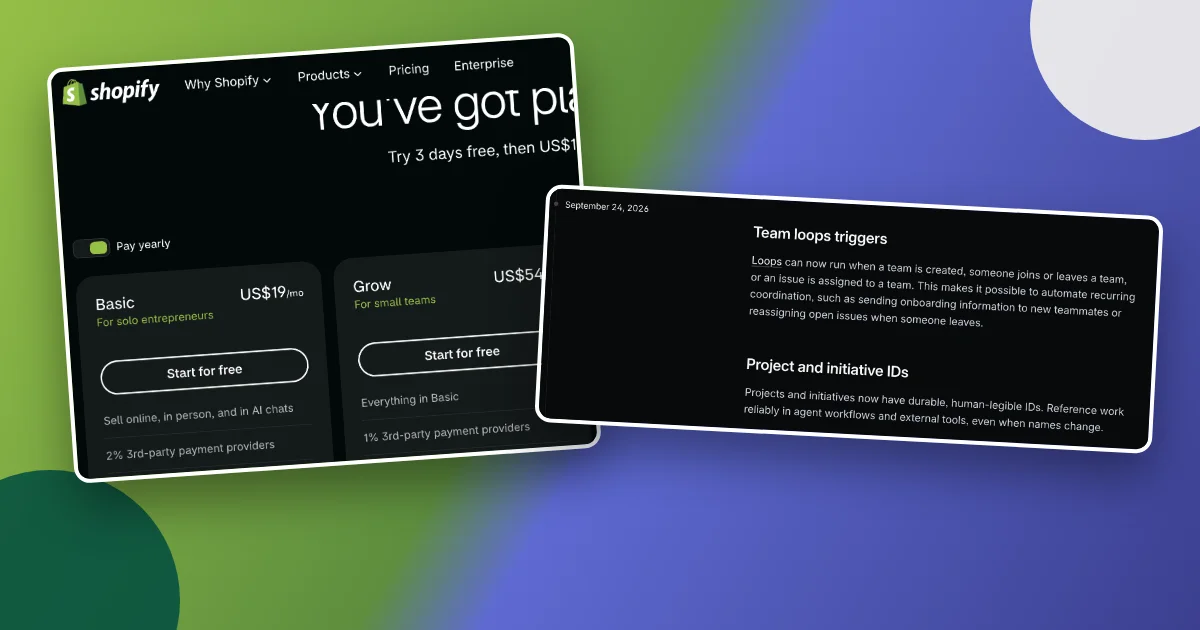
The first thing I do on any AI visibility audit takes five minutes. I ask ChatGPT and Perplexity three questions about the brand: “What are [Brand]’s fees?” “Is [Brand] legit?” “How do I close my [Brand] account?” Then I look at the sources each answer cites.
For questions about the brand’s own facts, I often find the answer coming from review sites, Reddit threads, comparison blogs and old news articles instead of the brand itself. That isn’t a PR problem. It is a content problem. Either the brand never published the answer, or AI can’t find, read or trust the one it did publish.
This is the first of two guides. Here I cover the 11 first-party sources, the pages you publish yourself, that give AI an official answer to cite. The second covers the third-party sources and media that decide whether AI recommends you. I’ve also built a free brand question map so you can measure where you stand today.
Copy question mapDownload Excel
Quick answer: First-party sources are pages you publish on your own domain that state facts about your brand: your about page, pricing, help centre, policies, availability, changelog, announcements, press kit, research, case studies and free tools. AI assistants use them as the official answer to factual questions about you, as long as they exist, are easy to read and stay up to date.
Why first-party sources matter more in AI search
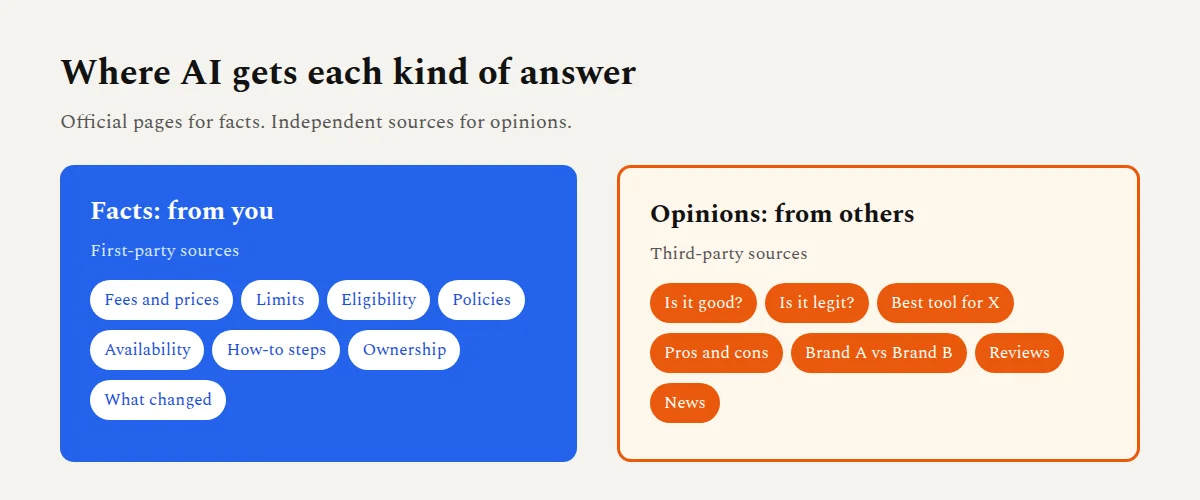
The research points to a pattern: AI leans on official pages for factual questions, and on third-party sources for opinion and buying questions.
- Factual questions favour official pages. Yext analysed 6.8 million AI citations across Gemini, ChatGPT and Perplexity. For unbranded, objective questions, first-party websites and local pages made up nearly 60% of citations. Branded and subjective questions leaned more on listings and reviews.
- “How do I” questions favour brand-owned content. Muck Rack’s 2026 study found that when people ask what is happening in an industry, AI reaches for news coverage, but when they ask how to do something, it leans on reference and brand-owned material.
- Buying questions favour third parties. Shero Commerce looked at purchasing questions across 60 product categories and found that only 2.8% of the 1,851 sources cited by Google AI Mode, ChatGPT and Perplexity were brand-owned pages.
The engines also differ. In Yext’s data, Gemini cited brand-owned websites far more than ChatGPT did. So treat this as a tendency, not a rule.
The practical point holds either way. For facts about your brand, an official page that exists, is easy to retrieve and states the answer clearly gives AI the right source. Without one, AI has to rely on whatever else it finds, which may be out of date.
Aleyda Solis’s prioritisation framework, which I also covered in my guide to help centre articles, scores most of these first-party content types high for citation potential.
The 11 first-party sources
1. About and company facts page
Answers: What is [Brand]? Who owns it? Who founded it? Where is it based? Is it regulated?
This is your entity page: the one place that states who you are in plain facts. Put the essentials in the first paragraph: what you do, for whom, founding year, headquarters, ownership and regulators. Add Organization schema with sameAs links to your official profiles. I do the same for my own name: my About page states my role, experience and background in plain text, so AI assistants have an official answer when someone asks who I am. If this page is vague or missing, AI may fill the gaps from business registries and database profiles, which are not always up to date.
2. Pricing and fees page
Answers: How much does [Brand] cost? What are the fees? Is there a free plan?
Pricing is one of the first things buyers check, and a wrong fee is one of the most damaging things AI can repeat. State every fee in plain HTML text, not inside a JavaScript widget, and show a table where possible.
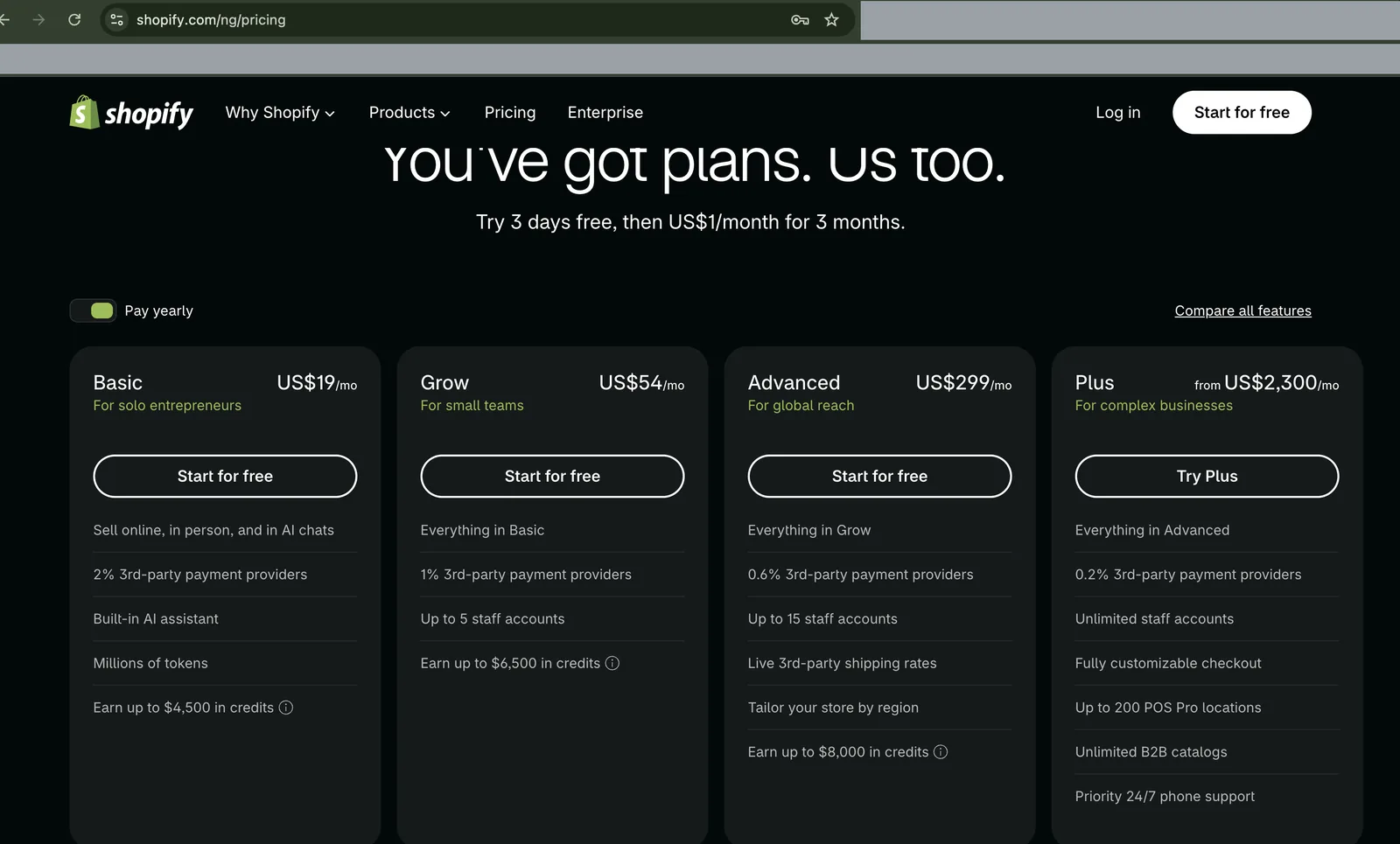
Shopify shows why this matters. Its pricing page sets out four plans side by side: Basic, Grow, Advanced and Plus, each with its monthly price and the fee for using third-party payment providers, from 2% on Basic down to 0.2% on Plus. It also has a version for each market. The Nigeria page I captured shows prices in US dollars, billed yearly.
Now search for Shopify’s pricing and read the third-party roundups. Some list the current plan names. Others, like this roundup, still compare plans called Basic, Shopify and Advanced, which is not what Shopify’s own page shows today. AI reads all of them. The official page only wins if it is clear, current and easy to retrieve, with the price for every market you sell in.
3. Help centre articles
Answers: How do I do X? Why did Y happen? What are the limits?
Your help centre can be one of your most-cited first-party sources, because every article is a specific, branded answer to a real question. In my guide to help centre articles I shared data where help pages drew a far bigger share of AI impressions than their share of the site. Airbnb’s Help Centre is a good model: it is on Airbnb’s own domain, split into guest and host sections, and full of articles on the exact questions people ask AI, such as cancellations, refunds and service fees.
One condition: the help centre has to live on your own domain or subdomain. On a help desk vendor’s default domain, the citations credit their domain, not yours. I cover this in detail in my guide to help centre AI citations.
4. Policies and eligibility pages
Answers: Who can sign up? Which documents do I need? What’s the refund policy? Why was my account restricted?
Terms, acceptable use, refund, privacy and eligibility rules are where AI looks when someone asks a sensitive question about you. Write a plain-language summary at the top of each legal page, then link to the full text. Give eligibility its own page, with a table by country or customer type.
5. Live reference hubs
Answers: Is [Brand] available in my country? Is it down? What’s today’s rate?
Supported countries, service status, current rates and integration lists change often, so AI looks for the live official version. Keep one hub for each, update it automatically, and show the last-updated date. A public status page also stops AI quoting a three-month-old outage as if it were happening now.
6. Changelog and release notes
Answers: Does [Brand] have feature X now? What changed?
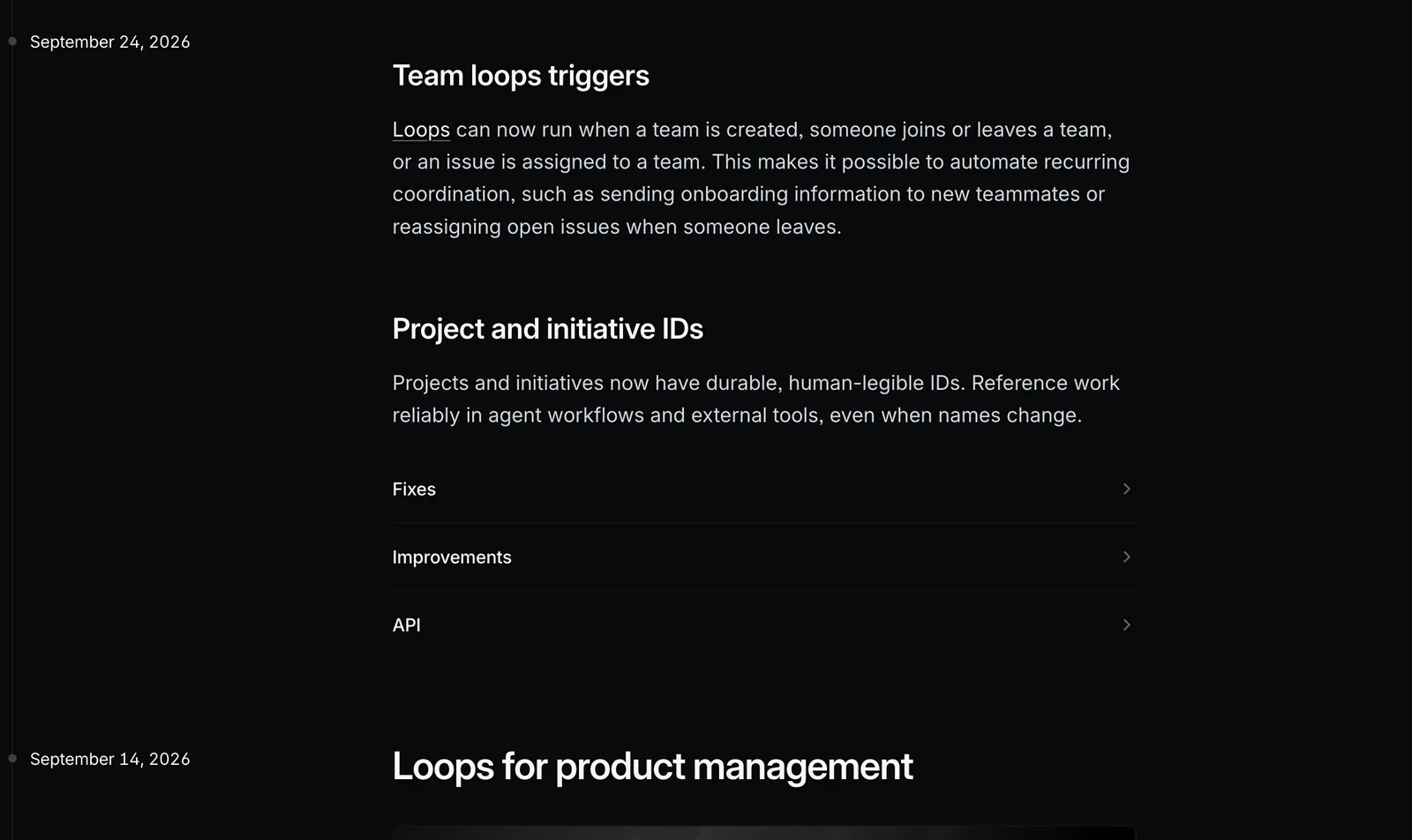
When AI says you don’t support a feature you launched last month, it is often working from older pages. A dated changelog gives it the current picture. Linear’s changelog is a good example: dated releases, clear headlines and short explanations of what changed. Link each entry to the help article or product page it affects.
7. Product announcements on your own site
Answers: What did [Brand] launch? When does the price change? Which markets are new?
Most content prioritisation frameworks deprioritise press release rewrites, and they are right to, for other companies’ news. Your own announcements are different. When you launch a product, change pricing or enter a market, publish it on your own site with real detail: what changed, who it affects, when it applies and the new numbers in a table.
What doesn’t work: a three-line newswire release that links to your homepage. AI will cite the news site that covered it, and probably get a detail wrong.
8. Newsroom and press kit
Answers: Who leads [Brand]? What does its logo look like? What are its latest milestones?
Journalists copy from your press page, and AI reads both the page and the coverage it produces. Keep boilerplate, leadership, milestones and figures current, and make every asset downloadable in one place. I showed NerdWallet’s press kit as a model in my guide to PR and SEO.
9. Original research and data
Answers: What does [Brand]’s data show? How big is this market?
Data only you hold is one of the strongest first-party assets you can publish, because other sites cite it too, which gives AI more than one route back to you. Muck Rack’s “What Is AI Reading?” report is a good example: it is Muck Rack’s own data, published on its own site, and it has been widely covered, including by CMSWire. Publish the method, the sample size and the date, and give each headline finding its own short, quotable sentence.
10. Case studies and customer stories
Answers: Does [Brand] work for companies like mine? What results do customers get?
AI uses case studies when someone asks whether a product suits a specific situation. Stripe’s customer stories are a good example: named customers, their industry and the Stripe products they use. Lead with the measurable result, name the customer type and market, and keep the numbers specific. I write my own case studies the same way: the headline result in the title, a dated timeline, and the numbers with their source in every caption.
11. Calculators and free tools
Answers: How much will I receive? How much will this cost me? Am I eligible?
Tools that use your own data answer questions no third party can answer as well. NerdWallet is a good example in personal finance: its free calculators for mortgages, loans and savings sit alongside plain-language guides that explain the numbers. Put a short text explanation next to every tool, so crawlers that can’t run the tool still see the answer. Tools are also strong candidates for programmatic pages, as I explain in my guide to programmatic SEO.
Free tools don’t have to be calculators. On my own site I publish a Skill.md library: free, ready-to-use instruction files for running SEO and marketing work with AI assistants. Nobody else can publish that exact resource, and that is what makes a first-party asset worth citing.
Make every page citable
Whatever the page type: answer the question in the first sentence, keep facts in server-rendered HTML, show a last-updated date, use the customer’s words in headings, and make sure the same fact says the same thing everywhere. My content brief template builds these rules into every brief, so writers get them right first time.
How to measure your first-party citation share
You can run this check in an afternoon:
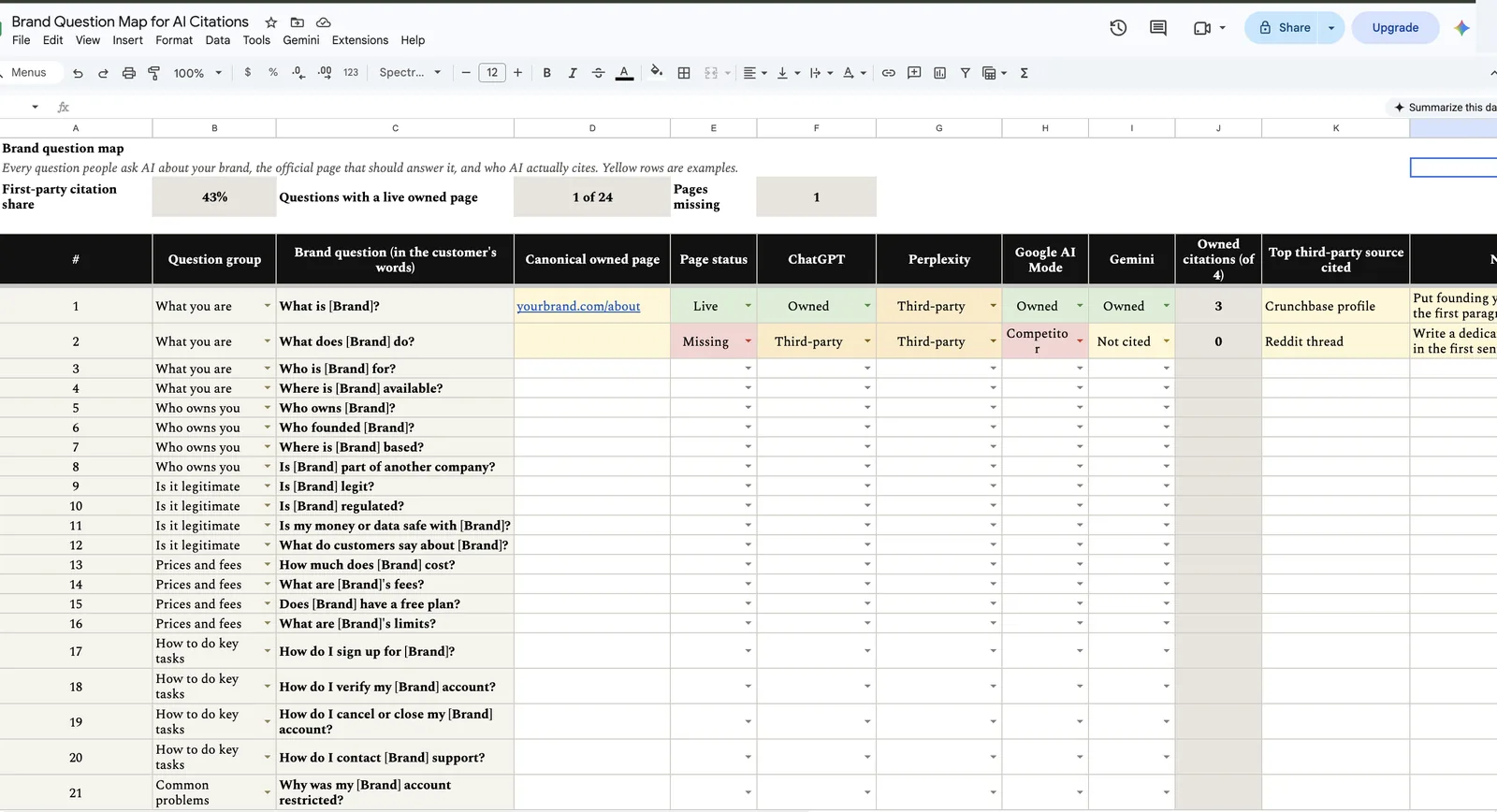
- List 20 to 30 brand questions across six groups: what you are, who owns you, whether you’re legitimate, prices and fees, how to do key tasks, and common problems.
- Ask each one in ChatGPT, Perplexity, Google AI Mode and Gemini with web search on.
- Log who gets cited for each answer: your own page, a third party, a competitor or nobody.
- Calculate your first-party share: owned citations divided by all citations.
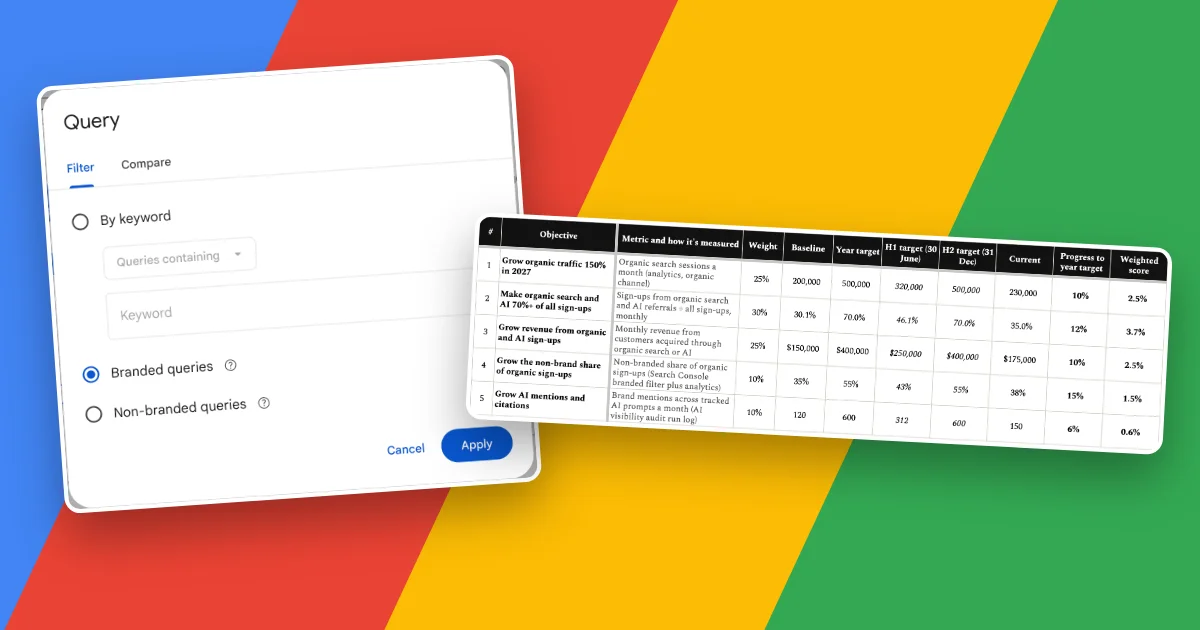
There’s no universal benchmark. But if third parties dominate answers to factual questions about your own product, treat it as a priority fix. I track first-party citation share as a leading indicator alongside AI mentions, inside the objectives scorecard from my guide to SEO goals.
The brand question map does this for you. It comes with 24 brand questions already written across the six groups. You log each engine’s top source from a dropdown, and it calculates your first-party citation share, how many questions have a live owned page, and how many pages are missing.
Why AI cites third parties instead, and how to fix it
| Why AI cites third parties | Fix |
|---|---|
| You never published the answer | Map every brand question to one owned page. Write the missing ones. |
| The answer is buried in a long page | Give key facts their own page or section, with the answer in the first sentence. |
| Key facts load through JavaScript | Put prices, fees and limits in the server-rendered HTML. |
| AI crawlers are blocked or time out | Allow live AI fetchers and fix slow pages. My AI visibility audit covers both. |
| Your facts contradict each other | Keep one master record and update every page, listing and profile from it. |
| Your help centre is on a vendor domain | Move it to your own domain or subdomain. |
| Pages are outdated | Show last-updated dates and review key facts every quarter. |
Third-party sources are the bigger half of GEO
First-party pages decide whether AI gets your facts right. Third-party sources decide whether AI mentions and recommends you at all, and the research suggests they make up most of what AI cites:
- McKinsey’s research on AI search found that brand-owned sites make up only 5% to 10% of the sources AI-powered search references.
- Muck Rack’s analysis of more than 25 million cited links found that 84% came from earned media, and that share held between 82% and 89% across three editions of the study.
- For buying questions, Shero Commerce found brand-owned pages were just 2.8% of the sources AI cited.
My view
Earned, third-party coverage is probably the most important part of GEO. Depending on the study and the type of question, your own pages supply somewhere between about 3% and 10% of what AI cites. Get those pages right, because they protect your facts. But most of the work that gets you recommended happens on other people’s sites.
There is one exception worth knowing. For factual and location-based questions, Yext’s data shows official pages carry far more weight, which is why the first-party sources above still matter. The goal is a clear split: facts about your brand should come from you, and opinions about your brand should come from many independent sources that agree. As I showed in my piece on self-promotional listicles, your own pages rarely win the recommendation on their own. My next guide covers the 12 third-party sources that do.
“If you don’t publish the answer about your brand, someone else will, and AI will believe them.”
Afeez Adebayo
Get the free brand question map
24 brand questions ready to test, a citation log for four AI engines and your first-party citation share, calculated automatically.
This is the work I do every week on AI search. If you want help finding the gaps in your first-party content, get in touch.